


New here? Join The Mobility Signal for on-the-ground intelligence from Southeast Asia’s automotive and mobility markets, built for industry leaders, investors, private equity, venture capital and advisors who need to understand what is changing and what it means.
Three Transformations, One Physical Constraint
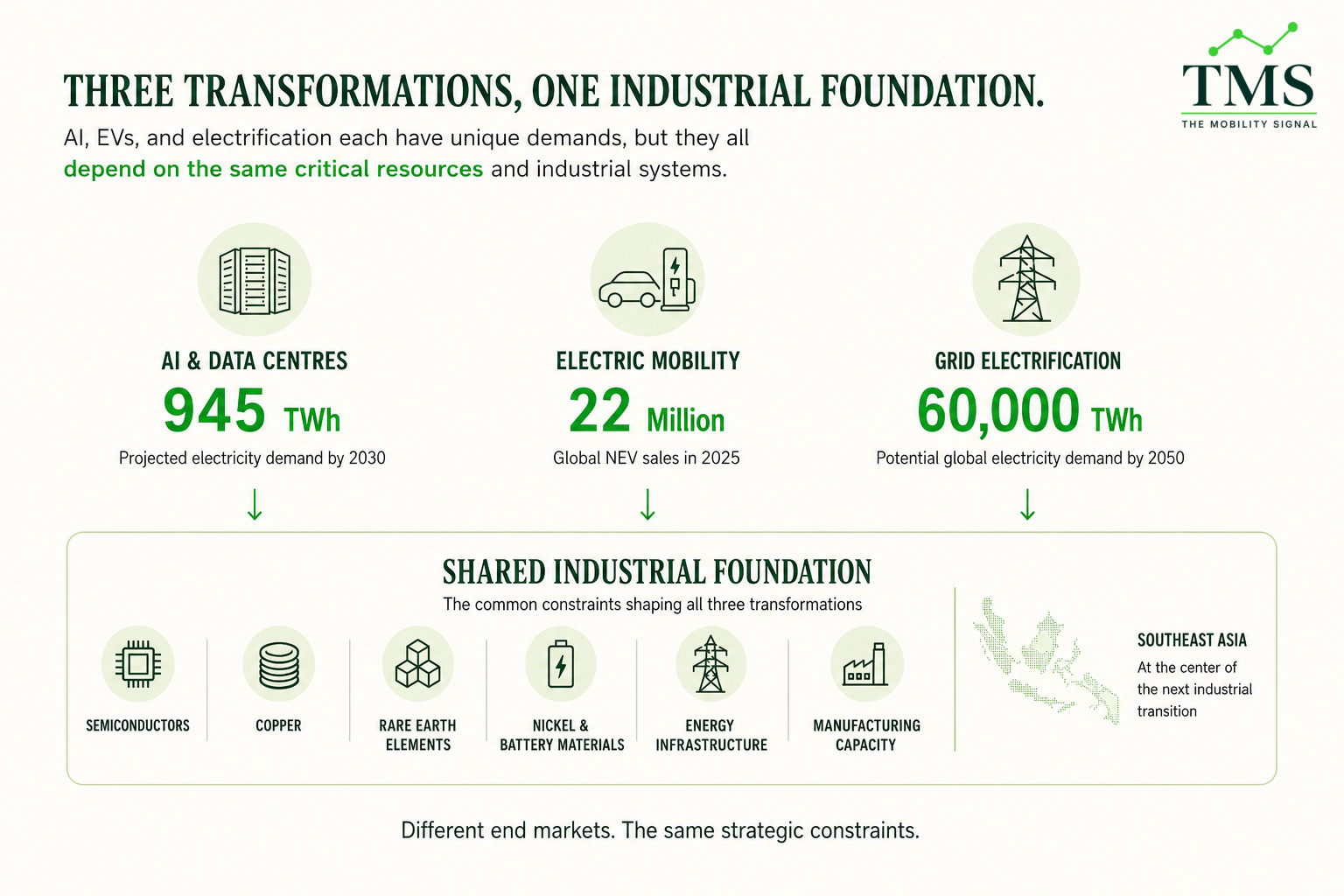
Artificial intelligence, electrification, advanced manufacturing, and the energy transition are reshaping the global economy. Unlike previous industrial cycles, however, these transformations are advancing simultaneously, creating unprecedented demand for many of the same industrial capabilities and placing renewed importance on industrial ecosystems. As these industries compete for semiconductors, critical minerals, electricity, manufacturing capacity, logistics, and skilled labor, competitive advantage is increasingly determined not by leadership in any single technology, but by the ability to build the industrial ecosystems that support them all.
The next industrial competition is not between technologies, but for the industrial capacity needed to deploy them at scale.
The challenge is no longer simply the availability of raw materials, but the ability to expand the systems that extract, refine, manufacture, transport, and deploy them. Mines, refineries, semiconductor fabrication plants, electricity networks, factories, and logistics infrastructure all require years to develop, while demand for new technologies can accelerate within months.
For Southeast Asia, this convergence presents both a challenge and an opportunity. As governments pursue digitalisation, industrialisation, energy security, and electric mobility simultaneously, the region is emerging as an important hub for the supply chains supporting all three transformations. The defining question is no longer whether these technologies will continue to grow, but whether Southeast Asia can build the industrial ecosystem needed to support them at the speed and scale they require.
The Visible Constraints: Semiconductors, Minerals, and Power
Artificial intelligence, electric mobility, and the electrification of energy systems are placing unprecedented demand on three foundational inputs: semiconductors, critical minerals, and electricity. These are the most visible constraints shaping the next phase of manufacturing expansion, not because they are isolated challenges, but because they reveal how dependent modern technologies have become on the same underlying industrial systems.
Semiconductors: The Digital Foundation
Semiconductors underpin nearly every modern technology, from artificial intelligence and cloud computing to electric vehicles, industrial automation, and communications infrastructure. Demand is accelerating simultaneously across these industries, increasing pressure on fabrication capacity, advanced packaging, manufacturing equipment, specialized materials, and engineering talent.
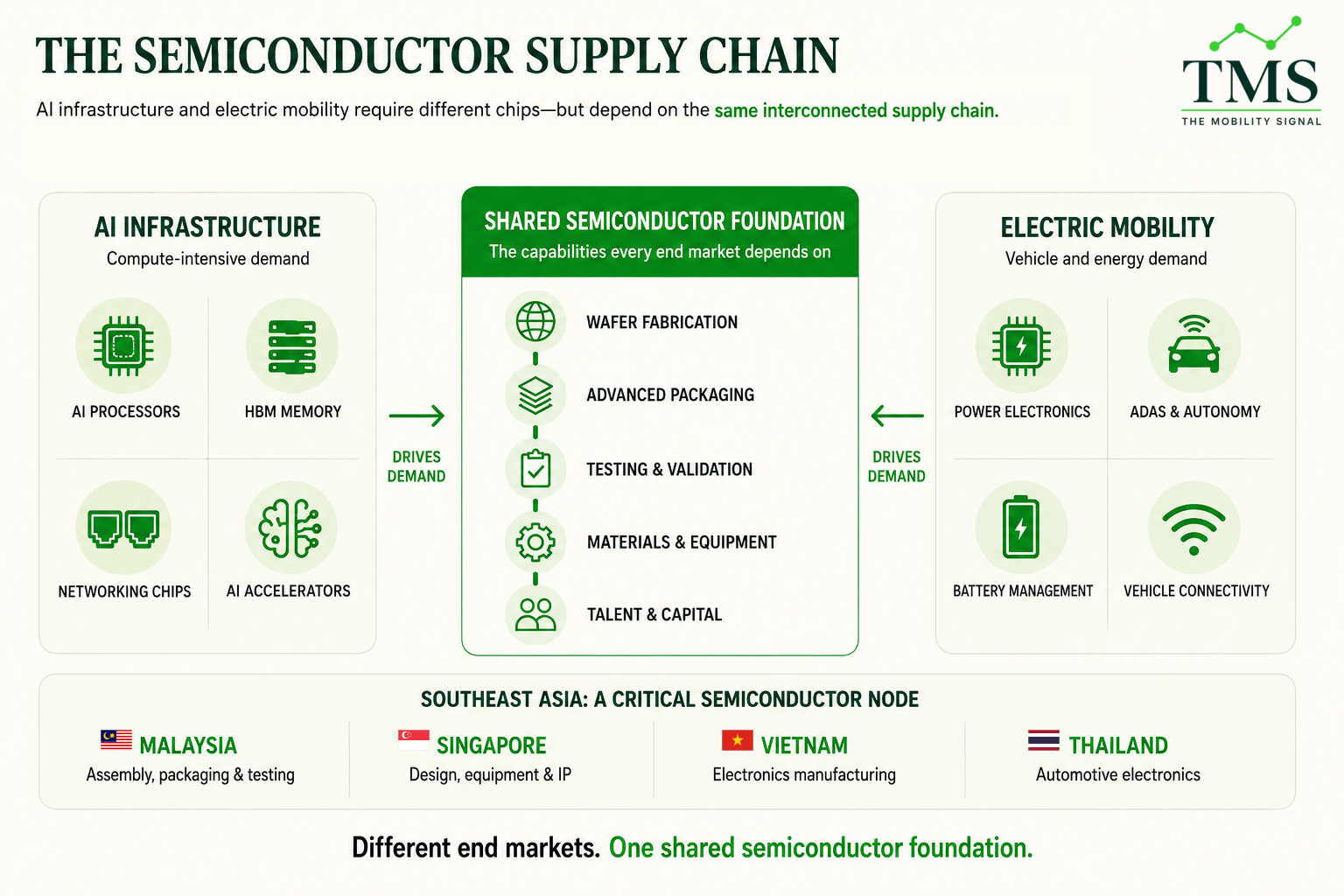
Figure 2: AI infrastructure and electric mobility compete for the same fabrication capacity, packaging, materials, equipment, and engineering talent.
Expanding semiconductor production is an industrial challenge as much as a technological one. New fabrication facilities require billions of dollars in investment, highly specialized equipment, skilled workforces, and years before reaching commercial production. As a result, manufacturing capacity expands far more slowly than demand.
Semiconductors have therefore become strategic industrial assets, with governments investing heavily in domestic manufacturing, supply-chain resilience, and advanced production capabilities.
Critical Minerals: The Material Foundation
Critical minerals underpin batteries, renewable energy, electricity networks, semiconductors, and advanced manufacturing. Growing investment across these industries is driving demand for copper, lithium, nickel, cobalt, graphite, rare earth elements, and other strategic materials.
Global new-energy vehicle sales reached approximately 22 million units in 2025, making electric mobility one of the largest sources of demand for critical minerals. At the same time, artificial intelligence is emerging as another important driver of mineral demand, particularly for copper used in data centres, electricity infrastructure, cooling systems, and grid connections. Together, these industries are placing increasing pressure on the mining, refining, and processing systems needed to supply them.
S&P Global estimates that AI and data centers could generate an additional 2 million metric tonnes of copper demand between 2025 and 2040.
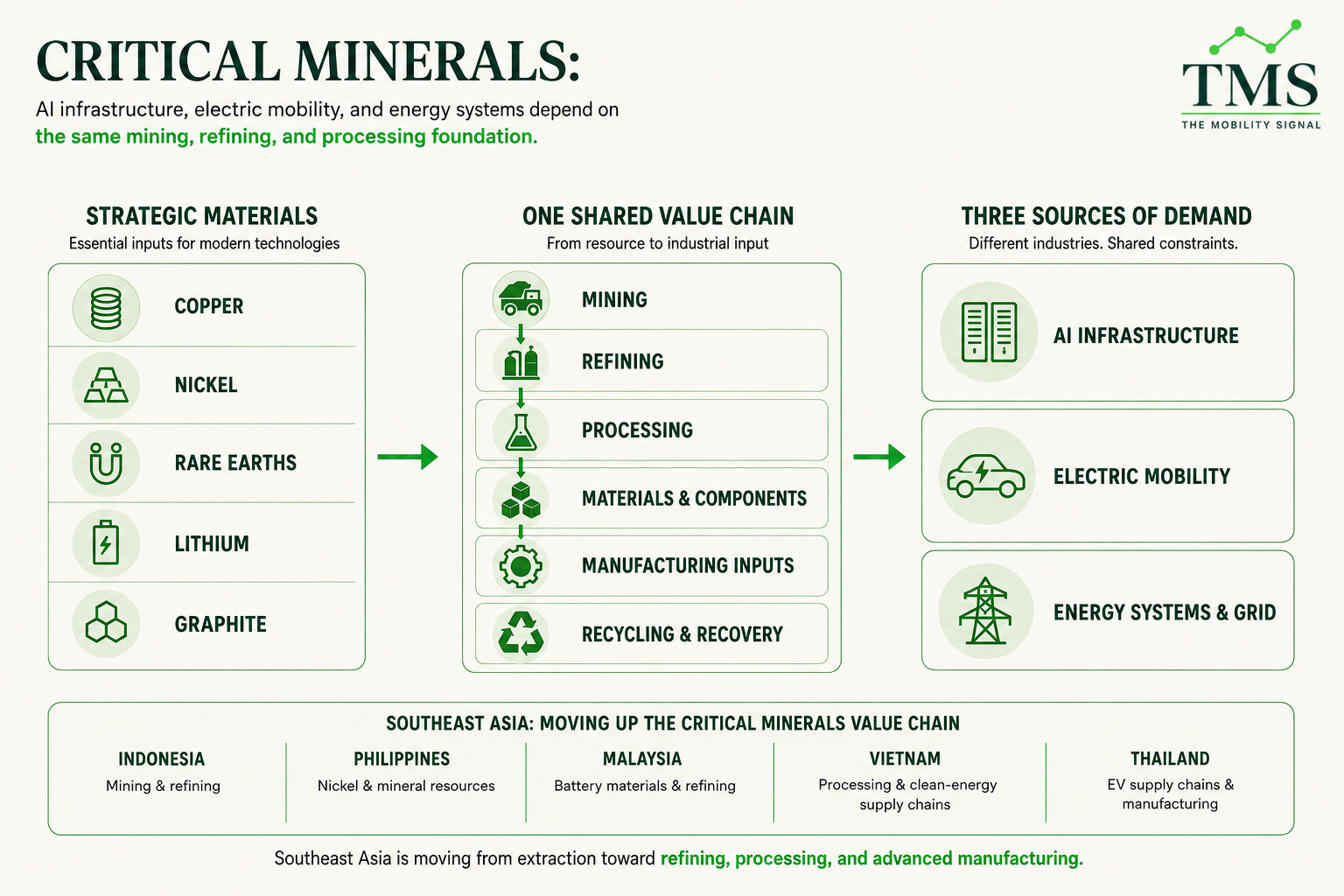
Figure 3: Copper, nickel, lithium, graphite, and rare earth elements support AI infrastructure, electric mobility, and grid expansion simultaneously.
The challenge is not geological scarcity, but the industrial capacity required to bring new supply to market. Expanding mineral production requires years of exploration, permitting, financing, mine development, refining, and processing before commercial production can begin.
The world is not running out of critical minerals; what will matter most is how quickly mining, refining, and processing can scale to meet growing demand.
This creates an opportunity for Southeast Asia and other regional economies, which are investing in downstream processing and advanced manufacturing to capture more value from global supply chains rather than exporting raw materials alone.
Energy Infrastructure: The Defining Industrial Constraint
Reliable, affordable, and scalable electricity underpins every modern industrial ecosystem, supporting semiconductor fabrication plants, AI data centres, electric vehicles, battery factories, renewable energy projects, and advanced manufacturing alike.
Electricity is the common thread linking the industrial transitions explored throughout this report. Semiconductor manufacturing, artificial intelligence, electric mobility, and the energy transition all depend on power systems capable of supporting rapid industrial expansion. As demand rises across these industries simultaneously, generation, transmission, distribution, storage, and grid infrastructure are coming under increasing pressure.
The International Energy Agency estimates that electricity consumption from data centers could more than double by 2030, rising from approximately 415 TWh in 2024 to around 945 TWh by the end of the decade. The additional 530 TWh of annual demand is roughly equivalent to adding a country the size of Germany to the global electricity system, or more than half of Japan’s current annual electricity consumption. Artificial intelligence is only one contributor to this growth alongside electric mobility, industrial electrification, and rising electricity demand across the broader economy.
Long-term forecasts suggest global electricity consumption could approach 60,000 TWh by mid-century, roughly double today’s levels. Meeting that demand will require the equivalent of another global electricity system to be built within the next twenty-five years.
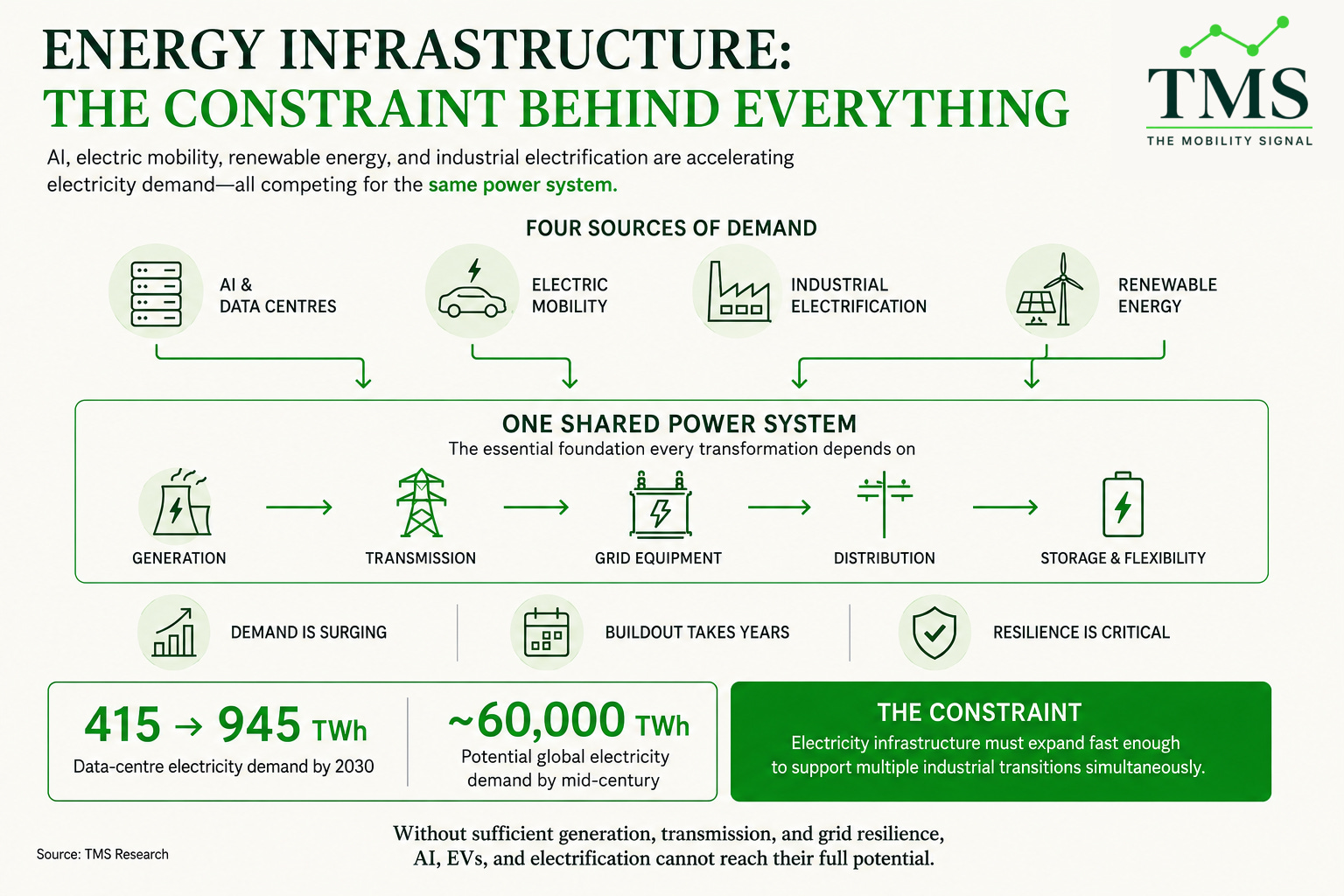
Figure 4: Artificial intelligence, electric mobility, renewable energy, and industrial electrification all depend on the same underlying electrical foundation of generation, transmission, distribution, storage, and grid infrastructure.
Semiconductors power intelligence, critical minerals enable electrification and electricity determines how fast both can grow.
The world is not short of energy resources; solar, wind, hydrocarbons, and nuclear power remain abundant across many regions. The constraint lies in how quickly generation, transmission, storage, and grid infrastructure can be expanded. New power plants often require years of planning and construction, major transmission projects take even longer, and grid upgrades frequently struggle to keep pace with rapidly changing patterns of demand.
These pressures are particularly evident in Southeast Asia, where economic growth, urbanisation, digitalisation, industrial expansion, and rising vehicle ownership are increasing electricity consumption while governments continue investing in renewable energy, industrial development, and digital infrastructure.
The ability to expand energy infrastructure will increasingly influence where investment flows, where manufacturing grows, and which economies capture the greatest value from artificial intelligence, electric mobility, and the energy transition. In this sense, electricity is no longer simply an input to industrial growth, it has become one of its defining enablers.
Southeast Asia: Where the New Industrial Economy Comes Together
Southeast Asia brings together many of the industries shaping the next industrial era, from critical minerals and semiconductor manufacturing to automotive production, digital infrastructure, and rapidly growing electricity demand, positioning the region as a focal point for the resources, infrastructure, and capital supporting all three.
No single Southeast Asian economy participates across every stage of the emerging industrial landscape, instead, the region's strength lies in the complementary capabilities of its economies. Indonesia and the Philippines contribute critical mineral resources, Malaysia strengthens semiconductor manufacturing, Thailand anchors automotive production, Vietnam expands advanced manufacturing and electronics, while Singapore provides regional leadership in finance, logistics, technology, and digital infrastructure. Together, these complementary strengths position Southeast Asia across many of the supply chains supporting artificial intelligence, semiconductors, electric vehicles, and the energy transition (Figure 6).
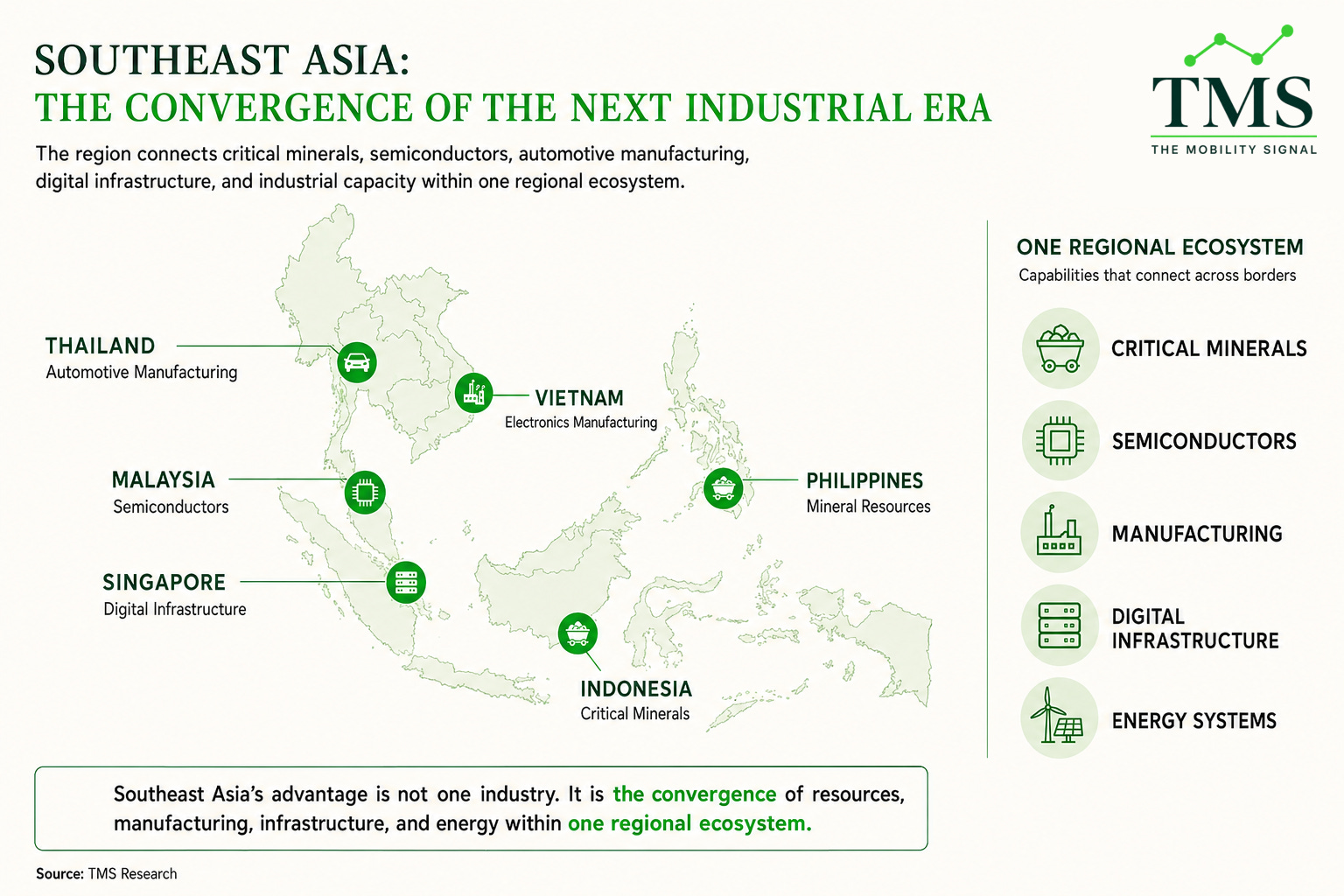
Figure 6: Southeast Asia's competitive advantage lies in the complementary strengths of its economies, creating a regional industrial ecosystem that supports artificial intelligence, semiconductors, electric mobility, and the energy transition.
The convergence of artificial intelligence, semiconductors, electric mobility, renewable energy, and digital infrastructure is creating a new wave of industrial investment across Southeast Asia. Capturing its full economic potential, however, will depend on the region's ability to expand the industrial capabilities that support these industries, from reliable electricity and logistics to skilled workforces and modern infrastructure.
Malaysia: Semiconductors, Data Centers, and Power Demand
Malaysia illustrates how artificial intelligence is reshaping industrial demand across Southeast Asia. Long established as one of the world’s leading semiconductor manufacturing hubs, the country accounts for an estimated 13% of global semiconductor assembly, testing, and packaging (ATP) activity while continuing to attract investment in advanced electronics. More recently, it has also emerged as one of the region’s leading destinations for hyperscale data centers, driven by strong digital infrastructure, competitive operating costs, and strategic proximity to Singapore.
Between 2021 and the first half of 2025, Malaysia approved RM144.4 billion ( ≈ US$34.0 billion) in data center investments, while Johor alone approved 42 projects valued at RM164.45 billion (≈ US$38.7 billion). According to ISEAS, electricity demand from Malaysian data centres could exceed 5,000 MW by 2035, equivalent to roughly 40% of Peninsular Malaysia’s current peak electricity demand.
Malaysia's success in attracting semiconductor manufacturing and AI infrastructure is shifting the focus from investment attraction to industrial expansion, where sustaining that momentum will require the infrastructure and skilled workforce needed to support continued investment at scale.
Indonesia: Nickel, Batteries, and Downstream Industrialization
Indonesia is the world’s largest producer of nickel, accounting for approximately 51% of global mine production and 42% of global reserves in 2023. As a critical input for lithium-ion batteries, stainless steel, and the broader energy transition, nickel has positioned Indonesia at the centre of global critical-mineral supply chains.
Rather than remaining solely a raw-material exporter, Indonesia has pursued an ambitious downstream industrialization strategy. Export restrictions on unprocessed nickel, combined with large-scale investment in refining, battery materials, and electric vehicle manufacturing, have attracted tens of billions of dollars in industrial investment. Global mining companies, battery manufacturers, and automotive producers have established a growing presence as the country builds an integrated battery and EV manufacturing ecosystem.
Indonesia's next phase of competitiveness will depend on strengthening the industrial capabilities needed to move further up the battery and electric-vehicle value chain.
Philippines: Minerals, Power, and the Untapped Opportunity
The Philippines was the world’s second-largest nickel producer in 2023, with estimated output of around 330,000 metric tonnes, placing it behind only Indonesia in global production. The country also possesses substantial copper, gold, and other critical mineral resources that are becoming increasingly important to electrification, renewable energy, advanced manufacturing, and artificial intelligence infrastructure.
The Tampakan copper-gold project in Mindanao is widely regarded as one of the world’s largest undeveloped copper deposits, with estimated resources of approximately 15 million tonnes of copper and 17.6 million ounces of gold. If developed, projects of this scale could strengthen the Philippines’ position within the supply chains supporting grid expansion, electric mobility, and advanced manufacturing.
While the country’s resource endowment is significant, much of its participation in these supply chains remains concentrated in mineral extraction rather than downstream processing and higher-value manufacturing. Across Southeast Asia, Indonesia has expanded nickel refining and battery production, Malaysia has strengthened its position in semiconductors and data centres, and Thailand has built a competitive automotive manufacturing ecosystem, illustrating the value of developing industrial capacity alongside natural resources.
One of the Philippines’ principal challenges is the availability of reliable and competitively priced electricity. Power costs remain among the highest in Southeast Asia, reducing the competitiveness of energy-intensive industries such as mineral processing, battery materials, semiconductor manufacturing, and data centres. Continued investment in renewable energy, transmission infrastructure, and power-sector reforms could improve these conditions over time.
The country's long-term opportunity lies not only in its mineral resources, but in its ability to build the industrial capacity needed to transform them into higher-value economic activity through expanded energy infrastructure, stronger grid reliability, downstream processing, and advanced manufacturing investment.
Thailand: The Automotive Transition
Thailand has long been Southeast Asia’s leading automotive manufacturing hub, producing approximately 1.5 to 2 million vehicles annually while serving as a major export base for global automakers. As the industry shifts toward electric mobility, the country’s competitive advantage will increasingly depend on its ability to extend that manufacturing leadership into the next generation of automotive production.
Electric mobility is reshaping automotive manufacturing beyond vehicle assembly, increasing demand for batteries, charging infrastructure, semiconductors, power electronics, software, and closer integration with electricity networks. Thailand has responded with incentives designed to attract investment across each of these areas.
Chinese manufacturers, including BYD, Great Wall Motor, and SAIC, have expanded their presence in Thailand, while investment in battery production and EV assembly continues to grow. The transition to electric mobility represents both an opportunity and a strategic imperative. Thailand's long-standing leadership in automotive manufacturing will increasingly depend on how successfully it can adapt its industrial base to electric vehicles, batteries, power electronics, and the wider technologies shaping the future of mobility. Maintaining that leadership will require continual investment in the manufacturing capabilities and supply chains that support the next generation of the automotive industry.
Vietnam: Manufacturing Expansion and Electronics
Vietnam has become one of Asia’s fastest-growing manufacturing centers, benefiting from supply-chain diversification, export-oriented industrialization, and strong inflows of foreign direct investment. Electronics are now among the country’s largest export sectors, with major manufacturers including Samsung, Foxconn, and Intel establishing significant operations.
As manufacturing has become more technologically sophisticated, Vietnam has expanded its role across consumer electronics, industrial equipment, and higher-value technology products. This evolution is increasing demand for semiconductors, reliable electricity, skilled labour, industrial land, and modern logistics while strengthening the country’s position within global manufacturing supply chains.
Sustaining this momentum will depend on expanding the industrial capacity needed to support continued manufacturing growth. Vietnam's ability to attract the next generation of advanced manufacturing investment will increasingly depend on how quickly it can strengthen those supporting capabilities.
Singapore: Digital Infrastructure and Regional Capital
Singapore’s strengths lie not in mineral resources or large-scale manufacturing, but in finance, technology, logistics, and digital infrastructure. The city-state hosts regional headquarters for many of the companies investing across Southeast Asia’s semiconductor, artificial intelligence, renewable energy, and mobility industries, while remaining one of Asia’s leading hubs for data centers, cloud computing, financial services, and technology investment.
Singapore also attracts a disproportionate share of Southeast Asia's venture-capital investment, making it an important gateway for international capital entering the region while reinforcing its role in financing, coordinating, and supporting regional industrial transformation as investment in artificial intelligence, digital infrastructure, and advanced manufacturing continues to grow.
Together, Southeast Asia's economies contribute complementary capabilities across the industries shaping the next industrial era. Indonesia and the Philippines provide critical minerals, Malaysia strengthens semiconductor manufacturing, Thailand expands electric-vehicle production, Vietnam advances manufacturing, and Singapore connects capital, technology, and regional investment.
Capturing the next wave of industrial growth will depend on how quickly Southeast Asia can expand its energy systems, industrial capacity, transport infrastructure, and skilled workforce. The decisions made today on infrastructure, industrial policy, workforce development, and regional cooperation will help determine the region’s position within the global industrial economy for decades to come.
China's Industrial Scale Advantage
China demonstrates what can be achieved when every layer of an industrial ecosystem is developed together. Over the past two decades, the country has expanded mining, refining, manufacturing, electricity generation, logistics, and industrial infrastructure as complementary parts of a single industrial ecosystem. The result is unmatched scale across many of the industries driving artificial intelligence, electric mobility, and the energy transition.
China produced approximately 70% of the world's electric vehicles in 2024, reflecting the scale that can be achieved when manufacturing, supply chains, and industrial infrastructure are developed together.
China did not become a leader in electric vehicles or batteries through a single policy or technology. Industrial capability expanded across the entire value chain through sustained investment in mineral processing, battery materials, vehicle manufacturing, renewable energy, logistics, ports, and industrial infrastructure. Each stage reinforced the next, creating an integrated industrial ecosystem rather than a collection of separate industries.
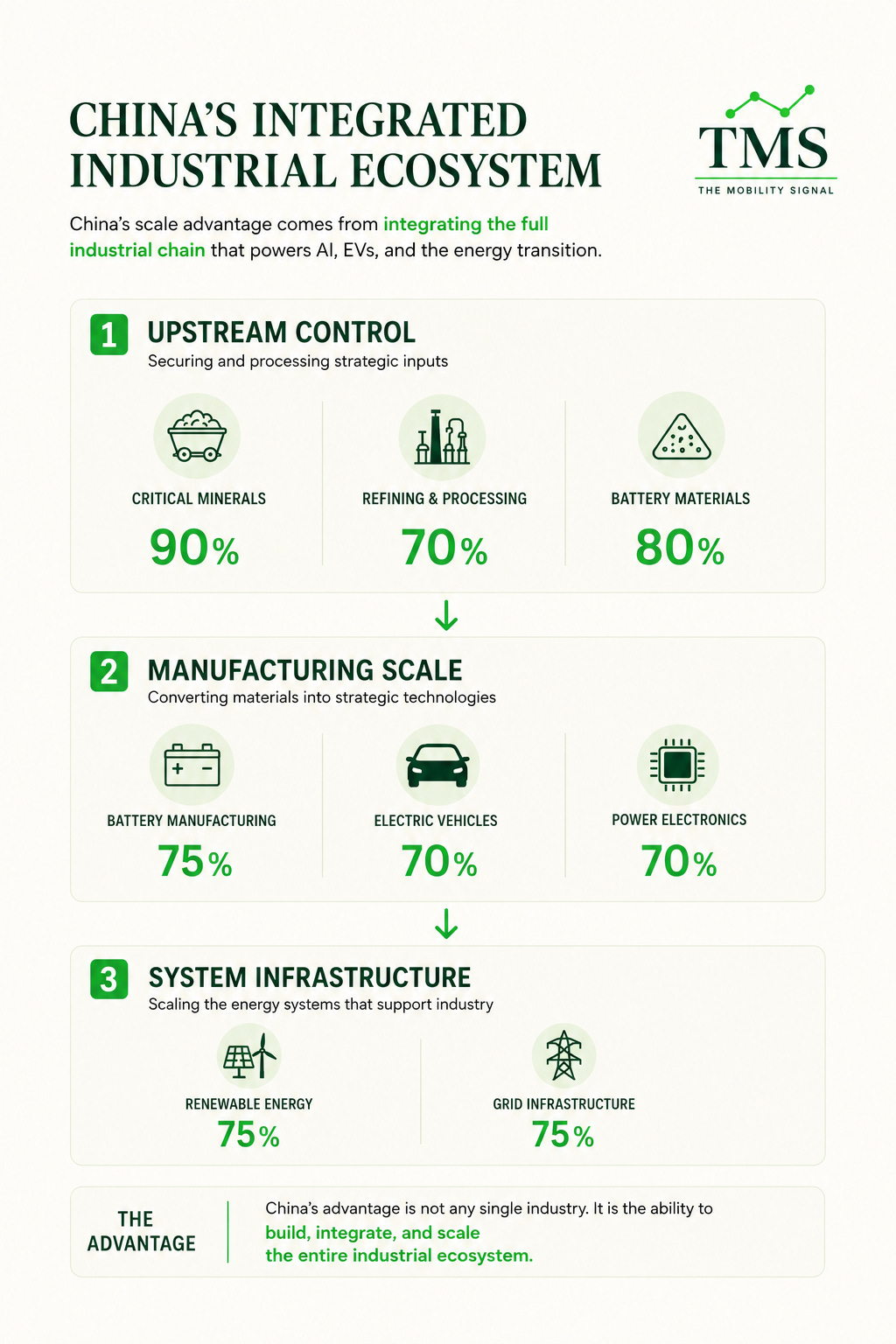
China's experience suggests that long-term industrial competitiveness depends less on leadership in any single technology than on building the systems that connect resources, manufacturing, energy, infrastructure, and logistics, offering Southeast Asia a different lesson, not to replicate China's scale, but to strengthen the complementary capabilities that already exist across the region.
EVs as Industrial Policy, Not Just Transportation
For many governments, electric vehicles have become less a transportation technology than a platform for industrial policy. Investment in electric mobility is strengthening manufacturing, advanced technology, energy infrastructure, and supply chains, reflecting a broader shift toward building the industrial capabilities that will underpin long-term economic competitiveness.
Electric mobility is strategically important because the capabilities it requires extend well beyond vehicle production. Investment in batteries, charging infrastructure, advanced manufacturing, and supporting supply chains strengthens many of the same industrial systems that underpin artificial intelligence, semiconductors, and the energy transition. For this reason, governments increasingly see electric mobility as a catalyst for building long-term industrial competitiveness.
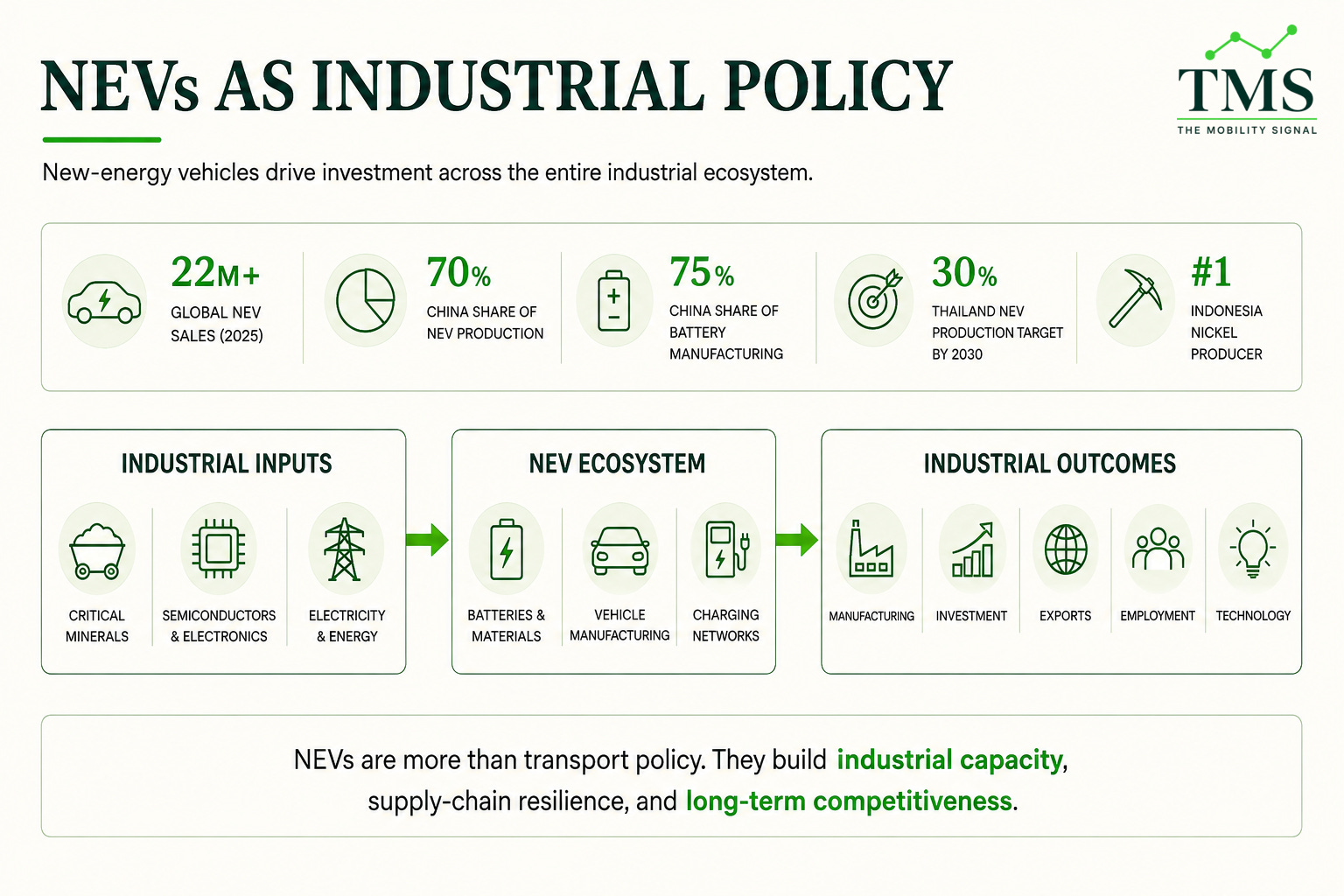
Global new-energy vehicle (NEV) sales reached approximately 22 million units in 2025, while China accounted for around 70% of global production. These figures illustrate how sustained industrial policy and long-term investment have created manufacturing capabilities that extend well beyond vehicle assembly, encompassing batteries, mineral processing, advanced manufacturing, and supporting supply chains.
Across Southeast Asia, governments are using electric mobility to strengthen manufacturing, attract investment, and deepen regional supply chains. Rather than focusing solely on vehicle production, governments are using EV investment to expand manufacturing, attract capital, deepen supply chains, and strengthen the capabilities that support long-term economic competitiveness.
Success will depend less on the number of electric vehicles a country sells than on how much of the surrounding industrial ecosystem it develops, as investment in batteries, advanced manufacturing, charging infrastructure, and supporting industries strengthens capabilities that extend well beyond the automotive sector.
Conclusion: The Next Industrial Race
The defining competition of the next industrial era will be determined not only by technological innovation, but by the ability to build the industrial systems that support it. Artificial intelligence, electric mobility, advanced manufacturing, and the energy transition increasingly depend on many of the same physical capabilities, including semiconductor manufacturing, critical minerals, reliable electricity, modern infrastructure, and skilled workforces.
These industries may appear separate, yet they are increasingly converging on the same underlying constraint: industrial capacity. The challenge is no longer simply inventing new technologies, but expanding the infrastructure, manufacturing capability, energy systems, logistics, and skilled workforce required to deploy them at scale.
Southeast Asia already possesses many of the ingredients required for long-term industrial competitiveness, including critical minerals, semiconductor manufacturing, advanced industry, digital infrastructure, and growing energy systems. Turning these strengths into a larger role in the next wave of global investment will depend on expanding the industrial ecosystems that connect these capabilities at scale.
As competition for investment intensifies, capital will increasingly flow toward economies that can deploy infrastructure, scale production, integrate supply chains, and continually expand industrial capacity. Countries that strengthen these capabilities will be better positioned to attract advanced manufacturing, technology investment, and higher-value industries. Those that cannot risk remaining concentrated in lower-value activities while future investment is captured elsewhere.
Ultimately, the future will belong not only to those who imagine new technologies, but to those who can build the systems that bring them to life.
Resources
About the data: Statistics presented in this report are drawn from publicly available sources, including the International Energy Agency (IEA), United States Geological Survey (USGS), World Bank, national government agencies, and industry research organizations. Where appropriate, the most recent data available at the time of writing (primarily 2024–2025) has been used. Because reporting periods and methodologies vary across organizations, some figures may differ slightly between sources.
International Organizations
International Energy Agency (IEA). Global EV Outlook 2025.
International Energy Agency (IEA). Electricity 2025.
International Energy Agency (IEA). The Role of Critical Minerals in Clean Energy Transitions.
International Energy Agency (IEA). World Energy Outlook 2024.
Semiconductors
Semiconductor Industry Association (SIA)
SEMI (Semiconductor Equipment and Materials International)
McKinsey & Company – Semiconductor industry reports
Deloitte – Global Semiconductor Outlook
Artificial Intelligence & Data Centres
International Energy Agency (IEA) – Electricity demand from data centres
Goldman Sachs Research – AI and electricity demand
S&P Global – AI-driven copper demand
International Data Corporation (IDC) – Data centre market analysis
Critical Minerals
United States Geological Survey (USGS). Mineral Commodity Summaries 2024–2025.
S&P Global Market Intelligence
International Energy Agency (IEA)
Benchmark Mineral Intelligence
International Renewable Energy Agency (IRENA)
Electric Vehicles
International Energy Agency (IEA). Global EV Outlook 2025.
EV Volumes
Rho Motion
International Council on Clean Transportation (ICCT)
Southeast Asia
Malaysia
Malaysian Investment Development Authority (MIDA)
ISEAS – Yusof Ishak Institute
Malaysian Investment Performance Reports
Tenaga Nasional Berhad (TNB)
Indonesia
Indonesia Ministry of Energy and Mineral Resources
Indonesia Investment Coordinating Board (BKPM)
USGS
World Bank
Philippines
Department of Energy (Philippines)
Mines and Geosciences Bureau (MGB)
Reuters (Tampakan Project)
World Bank
Thailand
Thailand Board of Investment (BOI)
Electric Vehicle Association of Thailand (EVAT)
Vietnam
General Statistics Office of Vietnam
Ministry of Planning and Investment
World Bank
Singapore
Economic Development Board (EDB)
Enterprise Singapore
Monetary Authority of Singapore (MAS)
China
International Energy Agency
International Energy Agency – Global EV Outlook
China Association of Automobile Manufacturers (CAAM)
International Council on Clean Transportation (ICCT)
BloombergNEF
World Bank
Supporting Research
McKinsey & Company
Boston Consulting Group (BCG)
PwC
Deloitte
World Economic Forum
OECD
IMF
World Bank
Asian Development Bank (ADB)
News and Industry Sources
Reuters
Financial Times
Nikkei Asia
Bloomberg
CNBC
The Economist