


New here? Join The Mobility Signal for on-the-ground intelligence from Southeast Asia’s automotive and mobility markets, built for industry leaders, investors, private equity, venture capital and advisors who need to understand what is changing and what it means.
Silver is a small input with an outsized role
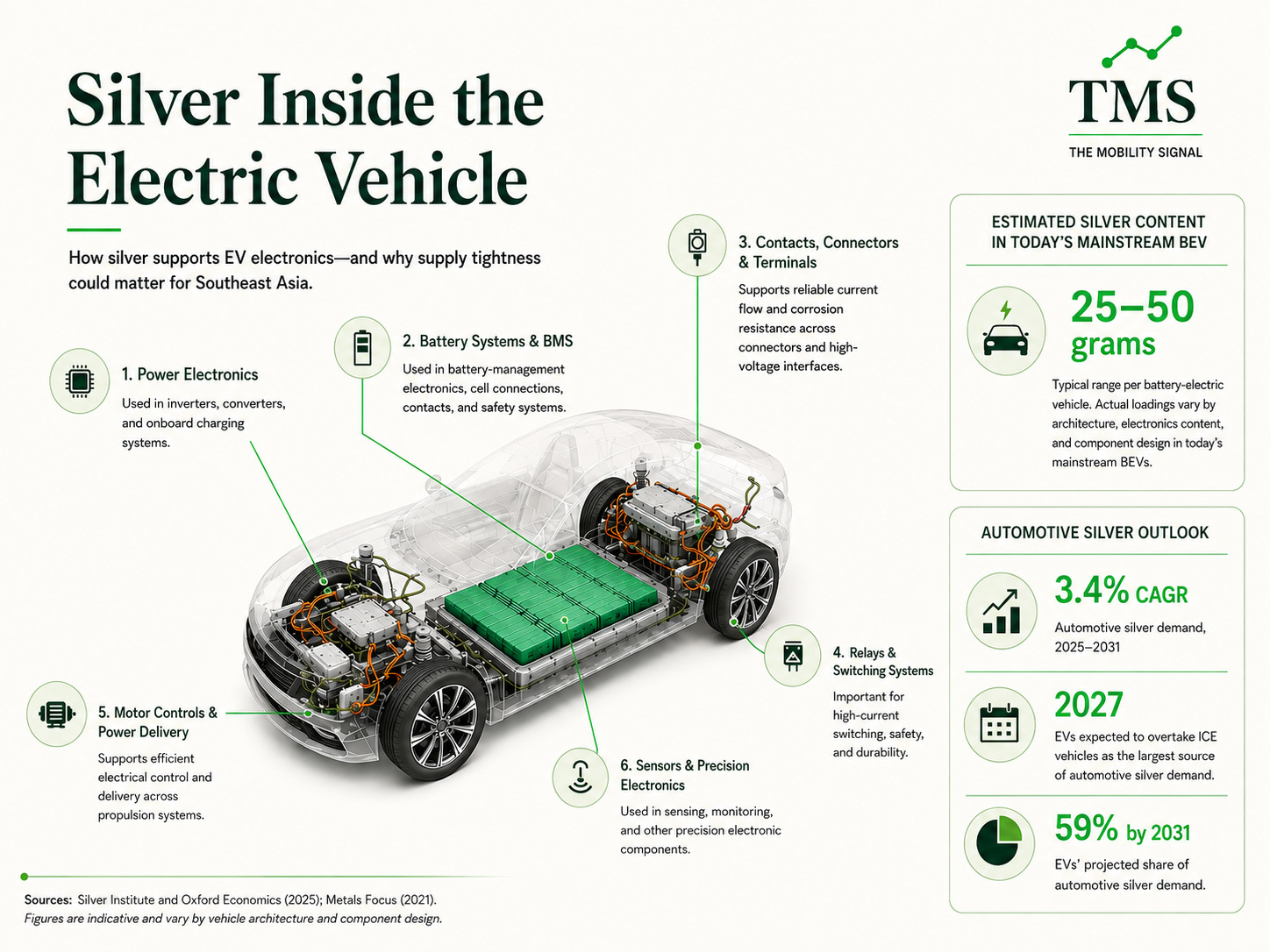
Silver receives far less attention than lithium, nickel or copper in discussions about the electric-vehicle supply chain, largely because it is used in much smaller quantities by weight, but has become much more important with the prevalence of electrified and connected vehicles, where it is used in relays, inverters, charging systems, sensors, battery-management electronics and other high-performance electrical components where conductivity and reliability are particularly important.
As vehicles become more electronically complex, the number of systems requiring these components continues to increase, which means battery-electric vehicles generally use more silver than comparable internal-combustion vehicles. Automotive demand is also developing alongside much larger sources of industrial consumption, including solar manufacturing, electronics and power infrastructure, creating greater competition for a material whose mine production has expanded relatively slowly and where new supply can take considerable time to develop.
For automakers, the significance is not whether there is enough silver to determine the future of electric mobility, but whether sustained industrial demand, constrained supply growth and greater price volatility turn a relatively small material input into a more meaningful procurement and cost consideration. If pressure on supply increased, then manufacturers would be incentivized to reduce silver volume through redesigning components and recovering more material through recycling.
These pressures are particularly relevant in Southeast Asia, where manufacturers compete across highly price-sensitive vehicle segments and relatively modest changes in production costs can influence vehicle pricing, financing and, ultimately, the pace at which electric vehicles become affordable to mass-market consumers.
Technology is reshaping the silver market
For much of its early history, silver was associated with jewellery, coins, bars, and its monetary role, although industrial demand has actually exceeded these individual uses for decades. More recently the composition and scale of industrial demand have changed, as older applications have declined and newer technologies expanded. A clear example is the decline of photographic demand, falling from 160.3 Moz in 2005 to 45.6 Moz in 2014, while photovoltaic demand increased from 7.3 Moz to 59.9 Moz over the same period.
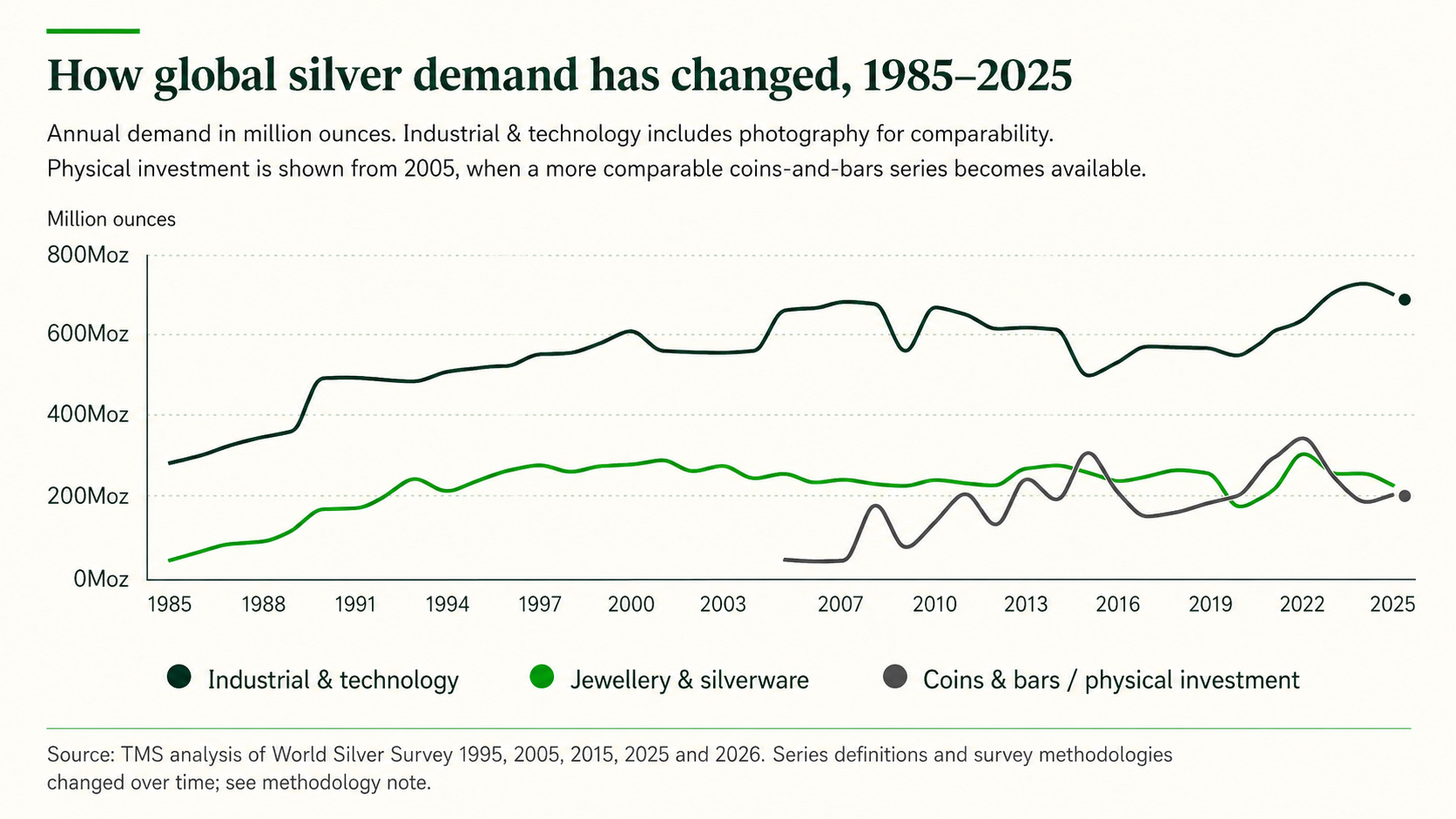
Since 2015, there has been a 49% increase in industrial demand, driven by photovoltaics at nearly three-fiths of the increase, alongside vehicle electrification, power grid investment and more recently AI and data infrastructure. In 2025, global silver demand totaled approximately 1.13 billion ounces, of which industrial applications accounted for 657.4 million ounces, roughly 58% of the total, making industrial use the largest component of silver demand.
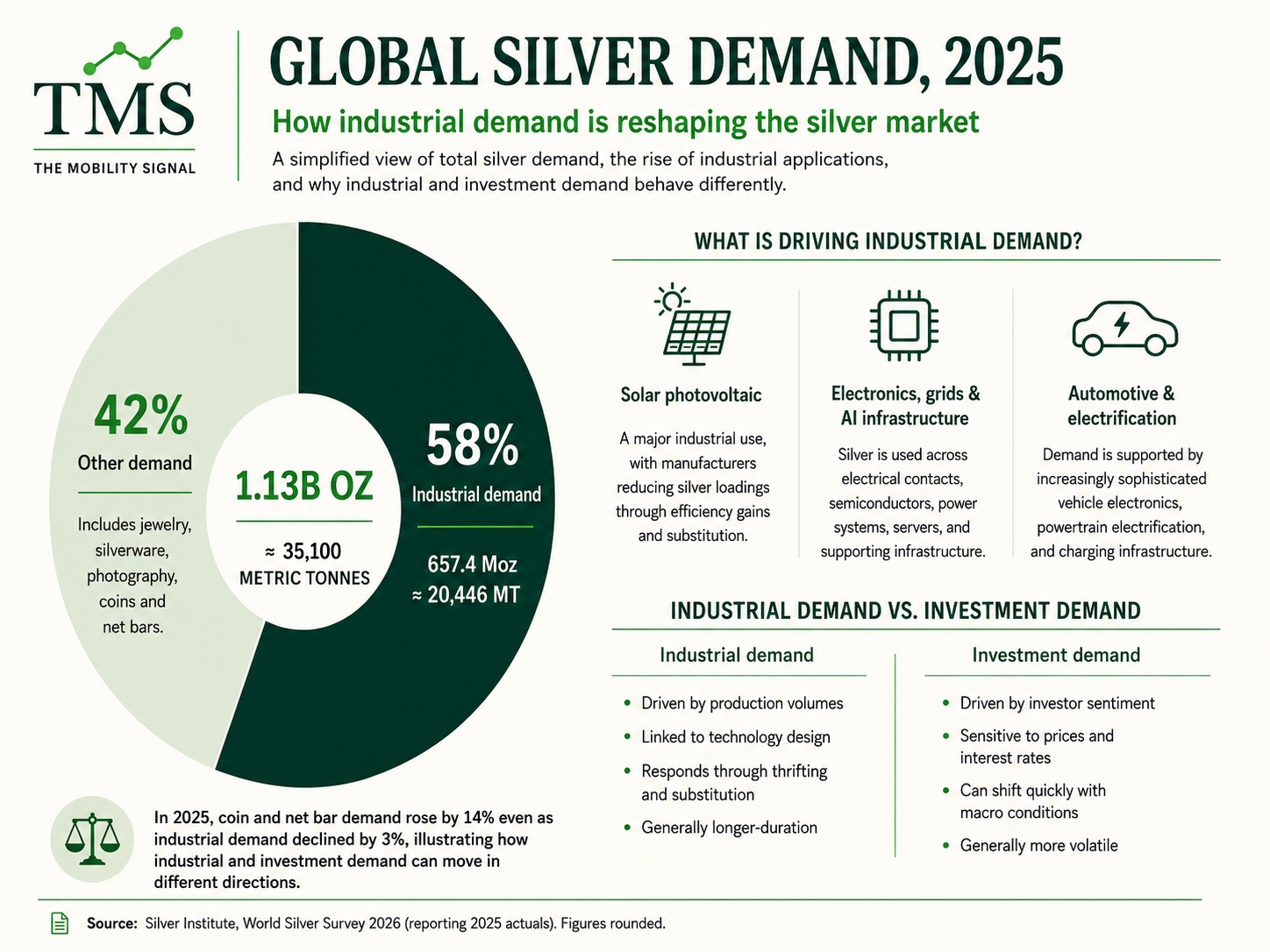
Industrial and investment demand behave differently and this was particularly evident in 2025. Since the pandemic there has been four consecutive years of growth, until 2025 when industrial silver demand declined by 3% to 657.4 Moz, mainly due to weaker voltaic demand and continuous silver thrifting. On the other hand coins and net bars moved in the other direction, increasing by 14% as investor interest strengthened in multiple markets.
The different factors influencing each side of the market help explain the divergence, with industrial consumption tied closely to production volumes, technology design, component requirements and the broader economic cycle, whereas investment demand can change quickly, with movements in price, interest rates, currencies and geopolitical uncertainty. The contrast in silver demand in 2025 is a good example of its industrial and precious metal role.
For mobility, automotive silver demand remains smaller than solar and the broader electronics sector, but it’s strategic importance is growing as vehicles incorporate more power electronics, sensors, switching systems, connectivity, and charging capability. The continued expansion of BEVs, PHEVs and HEVs, and charging networks, adds another source for continued industrial demand for silver.
Oxford Economics forecasts automotive silver demand to grow at a 3.4% compound annual rate between 2025 and 2031, with EVs expected to overtake internal-combustion vehicles as the largest source of automotive silver demand by 2027.
Higher silver prices are already encouraging greater recycling, material efficiency and substitution, meaning both supply and consumption can adjust over time and the future scale of the deficit is not fixed.
Supply responds slowly, while the size of the gap remains uncertain
Silver is expected to remain in a deficit in 2026, but the scale of the shortfall is relatively modest compared to expected market demand. The World Silver Survey 2026 forecasts total demand of approximately 1.11 billion ounces against supply of around 1.07 billion ounces, producing a deficit of 46.3 million ounces. This represents roughly 4% of annual demand and extends the market’s deficit into a sixth consecutive year.
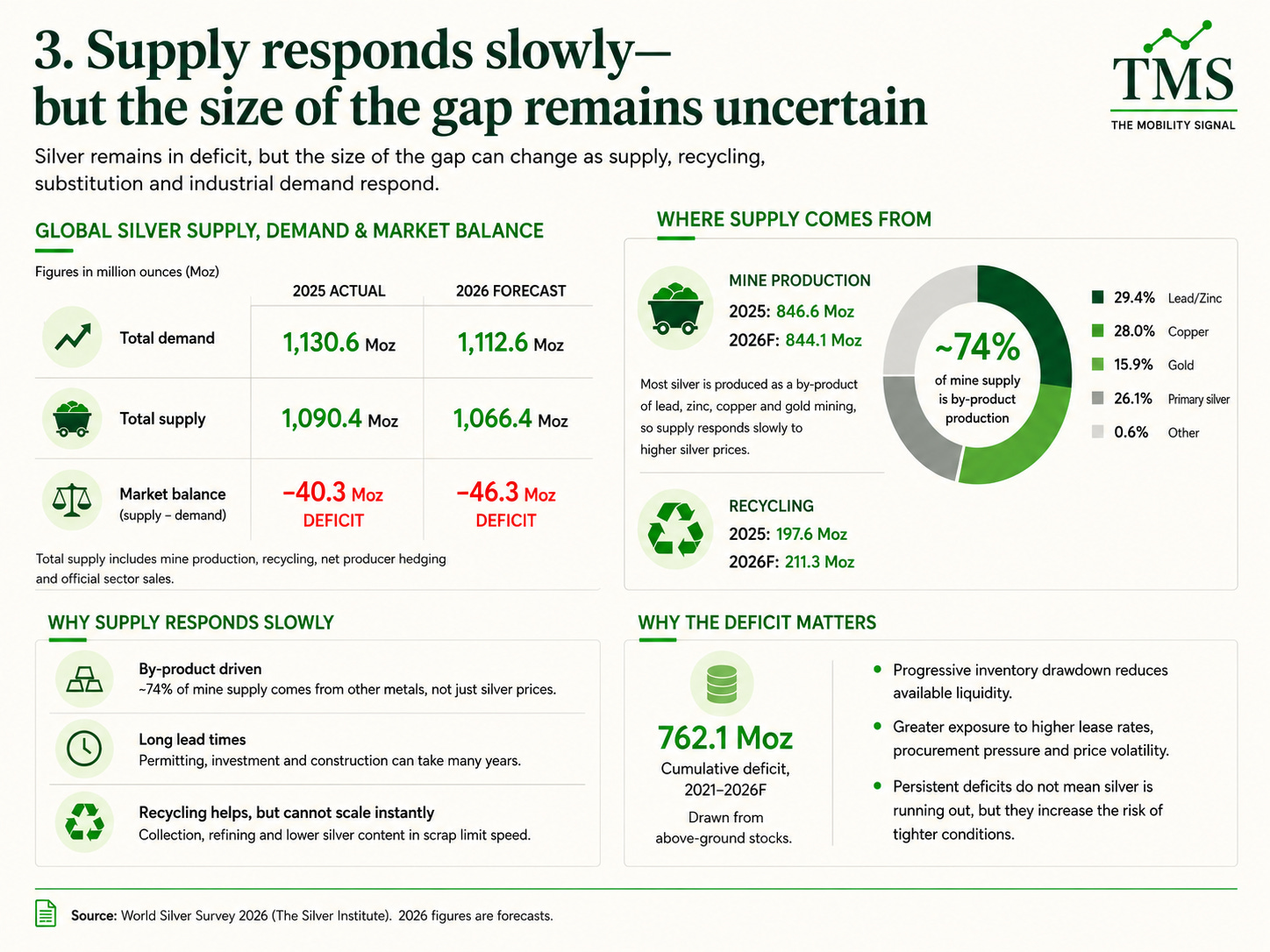
The slow supply response, is in part due to the structural nature of how silver is mined, with only 26% mined coming from silver mines. The rest of silver production is mainly from the by-product of mining gold, zinc and copper. This makes silver supply dependent on investment decisions and operating conditions in other metals markets, limiting how quickly higher silver prices can translate into additional mine production. Recycling of silver increased by 2% in 2025 and is forecast to grow by 7% in 2026, but refining and ability to find new scrap inventory is an on-going constraint.
The cumulative imbalance between 2021 and 2026 has resulted in an overall shortfall of 762.1 Moz, equivalent to nearly 1 year of global mining production. Above-ground inventories have helped manage these deficits, but the progressive drawdown has reduced the availability of silver in certain markets, causing elevated pricing and procurement pressure. This does not mean the world is running out of silver, but continued deficits can make the market more sensitive when inventories become strained or unavailable. With increasing silver prices encouraging recycling, material efficiency and investment interest, both sides of the silver market are enabling the constant change in supply and demand, meaning the future of Silver deficit is not fixed.
Persistent deficits can tighten liquidity, raise premiums and increase procurement volatility.
Electrification increases silver intensity
Electrification raises silver intensity as vehicles incorporate more power electronics, electrical controls and high-voltage systems. Oxford Economics estimates that battery-electric vehicles use, on average, 67–79% more silver than comparable internal-combustion vehicles, with approximately 25–50 grams in a mainstream BEVs, compared with earlier research estimates of 15–28 grams for an ICE vehicle and 18–34 grams for a hybrid.
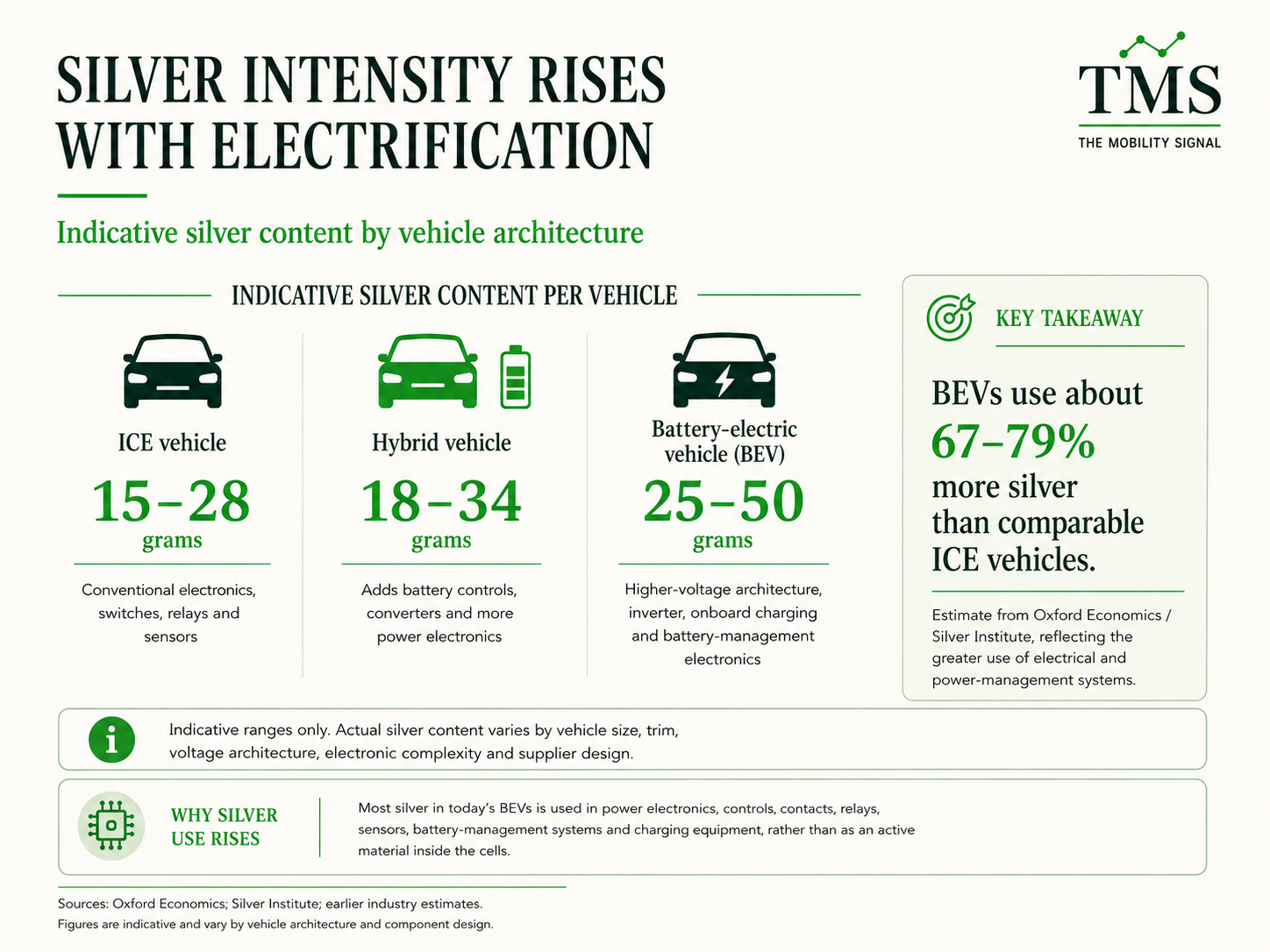
These ranges should be treated as directional benchmarks, rather than fixed requirements as silver content varies depending. on vehicle size, trim level, voltage architecture, electronic complexity and component design. A highly equipped ICE vehicle may therefore contain more silver than a basic hybrid, while a larger or more technologically advanced BEV may sit near the upper end of the published range.
Electrified vehicles currently use lithium-ion batteries, where most of the silver is used in the electrical systems and battery management, rather than directly in the cells themselves. Higher silver use reflects in the growing electrical complexity of the vehicle, charging infrastructure and driver assisted systems.
Next-generation battery architectures could change this relationship more substantially if silver begins to be incorporated directly into the battery cell.
Solid-state batteries could change the scale of demand
The key difference between lithium-ion and selected solid-state batteries is that silver is directly used in the cells of solid-state batteries, potentially increasing silver use substantially. Samsung-linked researchers have demonstrated an anode-free solid-state battery using a thin silver-carbon layer to help control how lithium is deposited during charging.
Samsung SDI is now developing its SolidStack all-solid-state platform. Samsung is targeting mass production in the second half of 2027. Samsung has not disclosed the silver content of a commercial cell or vehicle battery pack, making it difficult to estimate future demand from research-stage designs, manufacturers are also likely to reduce coating thickness, silver concentrations and overall material requirements as the technology develops.
The higher silver amounts considered in this article should be treated as technology scenarios rather than a forecast. A silver-carbon architecture using several hundred grams, and potentially close to 1 Kg per 100 kWh pack, would produce a significant increase from the tens of grams used in mainstream BEVs today, which could add a material cost to EVs, if silver prices remain elevated.
Today’s mainstream BEVs remain a tens-of-grams application for silver, while selected solid-state architectures could move that exposure into the hundreds of grams. The eventual commercial loading, however, remains uncertain.
What higher silver prices mean for vehicle economics
The impact of silver prices depends on how much silver is used in each vehicle architecture and how those costs move through the component supply chain. For a mainstream BEV, containing 25–50 grams of raw silver would be worth approximately US$48–$96 at US$60 per ounce, US$96–$193 at US$120 and US$161–$322 at US$200. With silver having traded above US$121 per ounce in January 2026, the US$120 scenario is no longer purely theoretical, while US$200 provides a more aggressive case for examining the impact of a substantially tighter market.
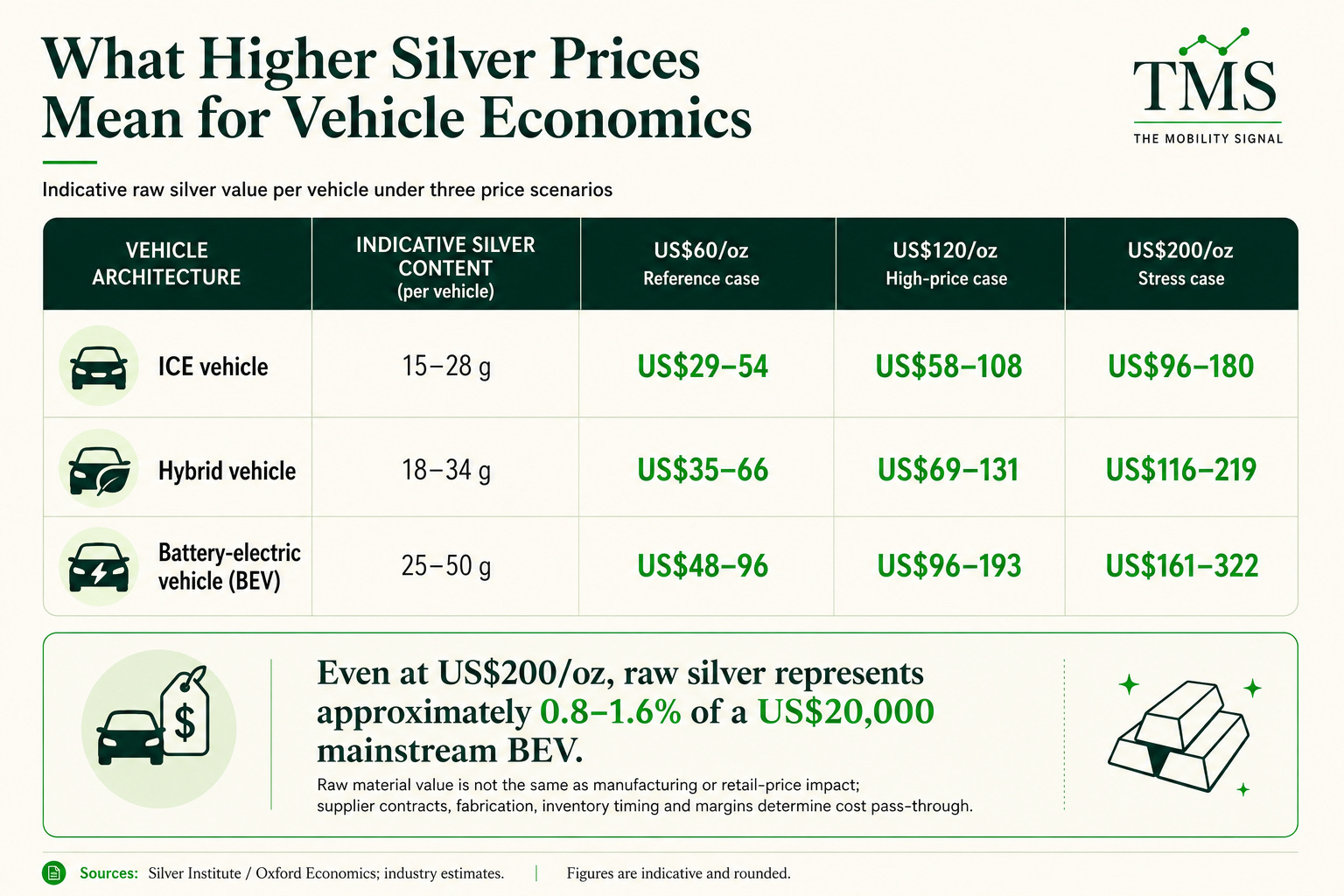
Even at US$200 per ounce, the raw silver contained in a mainstream BEV would represent only around 0.8–1.6% of a US$20,000 vehicle, and silver likely becomes an additional source of cost pressure, with raw exposure of roughly $100-$300 per vehicle under elevated pricing scenario’s becoming more significant when combined with increased costs for copper, batteries, semiconductors, logistics and compliance. Entry level segments will be most affected, where there is less margin to absorb additional costs, which is felt by the consumer, especially in price-sensitive countries like the Philippines.
Solid-state batteries create a different cost scenario
The economics could look very different if selected solid-state battery designs bring silver directly into the cell at loadings measured in hundreds of grams rather than tens. Because no manufacturer has disclosed a verified commercial silver requirement, the 500-gram and one-kilogram assumptions used here should be treated as technology scenarios, rather than Samsung, BYD or industry-standard bills of materials.
At those levels, silver would move from being a relatively small component cost to a more meaningful part of battery economics, giving manufacturers a strong incentive to reduce coating thickness and silver concentrations, improve cell efficiency, recover production scrap and develop alternative materials or interface designs. It also suggests that early high-silver solid-state vehicles would be more likely to appear first in premium segments, where higher material costs can be absorbed more easily, before reaching mass-market models.
Currently, silver remains a relatively modest cost, but in some solid-state designs, a much higher silver use will have a more meaningful impact on battery and vehicle pricing.
Why this matters for Southeast Asia
Southeast Asia is becoming one of the world’s fastest-growing electric-vehicle markets, with over half a million units in 2025 and accounting for close to one-fifth of new-car sales. Vietnam, Indonesia and Thailand led much of that growth, supported by policy incentives, expanding local production and a wider range of more affordable models.
Affordability remains one of the biggest factors shaping EV adoption across Southeast Asia, with prices in Thailand broadly reaching parity with comparable internal-combustion vehicles and the average BEV premium in Indonesia falling from more than 50% in 2024 to around 40% in 2025. Even so, price competitiveness still varies significantly by market and model, while entry-level buyers remain highly sensitive to monthly payments, financing costs and overall household budgets.
Silver is unlikely to determine mainstream EV affordability on its own, but it adds to a wider set of cost pressures across batteries, copper, semiconductors, logistics and financing, with exposure becoming more significant in selected solid-state platforms, which may require more silver. The challenge for manufacturers will be the ability to absorb, reduce silver concentration or localise costs, to keep reducing vehicle prices, particularly in mass-market segments in price sensitive countries.
This will most likely contribute to a more uneven electrified transition across the region, with mainstream lithium-ion BEVs becoming increasingly competitive as production scales and supply chains deepen, while volatile input costs and differences in local manufacturing capability delay price parity in some markets and keep hybrids relevant for longer. The longer-term outcome will depend less on the price of any single material than on whether manufacturers can reduce costs through localisation, scale, material efficiency and recovery, ultimately determining whether mass-market consumers can afford to buy, finance and own electric vehicles.
Silver is unlikely to stop Southeast Asia’s EV transition on it’s own, but it could influence how quickly affordable models reach the mass market and which technologies consumers adopt along the way.
References & Resources
Primary Silver Market & Automotive Research
The Silver Institute / Metals Focus — World Silver Survey 2026
Primary source for global silver supply and demand, industrial consumption, mine production, recycling, market deficits, above-ground inventory dynamics, and recent silver-market conditions.
Oxford Economics / The Silver Institute — Silver: The Next Generation Metal (2025)
Primary source for automotive silver-demand forecasts, the current 25–50 gram indicative mainstream BEV range, the estimate that BEVs use approximately 67–79% more silver than comparable ICE vehicles, and automotive silver-demand projections through 2031.
Metals Focus / The Silver Institute — Automotive Silver Research (2021)
Source for legacy indicative vehicle-content benchmarks of approximately 15–28 grams for ICE vehicles and 18–34 grams for hybrids. These are used as directional benchmarks rather than current 2026 averages.
Solid-State Battery & Next-Generation Technology Research
Nature Energy — Silver–Carbon Composite Anode Research (2020)
Peer-reviewed Samsung-linked research demonstrating an anode-free all-solid-state battery using a thin silver–carbon composite layer to regulate lithium deposition.
Nature Communications — Silver-Exsolution Solid-State Battery Research (2025)
Research demonstrating silver-doped solid electrolytes and nanoscale silver formation to improve lithium deposition in anode-free solid-state cells.
Nature Materials — Nanoscale Silver-Coating Research (2026)
Research showing how very thin silver-based treatments can improve the mechanical properties of ceramic solid electrolytes, illustrating that future silver requirements may vary substantially by architecture.
Samsung SDI — SolidStack / All-Solid-State Battery Development
Company disclosures covering Samsung SDI’s proprietary anode-free coating technology and its target for all-solid-state battery mass production in the second half of 2027. Samsung has not disclosed a verified commercial silver loading per cell or battery pack.
Electric Vehicles, Manufacturing & Southeast Asia
International Energy Agency — Global EV Outlook 2026
Primary source for global and Southeast Asian EV adoption, vehicle pricing, manufacturing capacity, imports, localisation trends, and regional electrification dynamics.
International Energy Agency — Manufacturing & Trade Analysis
Supporting source for Chinese automakers’ overseas manufacturing footprint, Thailand and Indonesia production capacity, plant utilisation, vehicle trade, and localisation trends.
ASEAN Centre for Energy
Regional energy-transition, electrification, charging-infrastructure and ASEAN policy research.
Asian Development Bank
Southeast Asian infrastructure, industrial development, transport and economic research.
Department of Energy Philippines
Philippine electric-vehicle, charging-infrastructure and energy-transition policy information.
Board of Investments Philippines
Philippine automotive manufacturing, EV investment incentives and industrial-development programmes.
Broader Energy, Technology & Industrial Research
These sources provide useful contextual research but are not the principal basis for the quantitative silver estimates in this article:
International Renewable Energy Agency (IRENA) — Renewable-energy deployment, solar capacity and energy-transition research.
BloombergNEF — EV, battery, renewable-energy and electrification market research.
Semiconductor Industry Association — Semiconductor demand, manufacturing and industry trends.
McKinsey & Company — Automotive manufacturing, batteries, supply chains and semiconductor research.
Deloitte Insights — Automotive, technology and semiconductor industry analysis.
World Economic Forum — Industrial supply chains, critical materials and energy-transition research.
Silver Prices & Market Commentary
World Silver Survey 2026 / Metals Focus
Primary reference for recent silver-market conditions, including the January 29, 2026 record above US$121 per ounce, liquidity conditions, premiums and lease rates.
CME Group — Precious-metals futures, inventories and derivatives-market data.
TradingView — Historical silver-price charting and market visualisation.
Kitco Metals — Precious-metals pricing and market commentary.
Michael Oliver / Momentum Structural Analysis — Technical and macro commentary on precious metals. Used as market perspective rather than as the basis for the article’s fundamental forecasts.
I would put GoldSilver, Investing.com, MiningVisuals and Newsbase in a separate category if we want to retain them at all:
Additional Market Commentary Reviewed
These sources were reviewed when assessing potential silver requirements in future solid-state batteries. Their estimates—particularly claims of approximately one kilogram of silver per 100 kWh pack—should not be interpreted as manufacturer specifications.
GoldSilver
Investing.com
MiningVisuals
Newsbase
That distinction is important because our final analysis does not accept the one-kilogram figure as a Samsung or BYD specification.
Notes & Assumptions
Silver market data. Historical market figures and the 2025–2026 outlook are based principally on the World Silver Survey 2026. Longer-term outcomes remain uncertain because higher prices can affect recycling, substitution, thrifting, investment demand and industrial consumption.
Vehicle silver content. Silver-content estimates vary according to vehicle size, electrical architecture, electronics content, voltage systems, component design and supplier choices. The 25–50 gram mainstream BEV range was reaffirmed by Oxford Economics in 2025, while the ICE and hybrid ranges used in the analysis are older industry benchmarks and should be treated as indicative.
Solid-state battery scenarios. There is currently no verified industry-standard silver loading for a commercial solid-state EV battery. The illustrative 500 gram and one kilogram per 100 kWh pack scenarios used in this article are technology sensitivities designed to explore the economics of potentially silver-intensive architectures. They are not Samsung, BYD or industry-standard bills of materials.
Silver-price scenarios. US$60, US$120 and US$200 per ounce are scenario assumptions rather than price forecasts. US$120 represents an observed high-price reference following silver’s January 2026 record above US$121, while US$200 is used as a stress scenario to test potential vehicle-cost exposure.
Vehicle-cost analysis. Calculations represent the approximate raw value of silver contained in a vehicle or battery architecture. They do not represent the final manufacturing or retail-price impact, which depends on supplier contracts, fabrication costs, hedging, inventories, margins, taxes, logistics, financing and component redesign.
Southeast Asia analysis. Regional conclusions combine published EV-market and manufacturing data with scenario analysis. Outcomes relating to future localisation, hybrid demand, solid-state adoption and consumer affordability should be interpreted as analytical implications rather than forecasts.
Charts and models. Visualisations combine published industry data with clearly identified analytical assumptions. Figures have been rounded where appropriate and may not sum precisely because of rounding.
This hierarchy gives the article a much stronger research footing: Silver Institute/Metals Focus + Oxford Economics for the silver and automotive thesis; peer-reviewed research + Samsung SDI for solid-state technology; and the IEA for the Southeast Asian mobility thesis.