


Understanding Southeast Asia Through Mobility
Southeast Asia is entering a new phase of economic and industrial development.
Automotive markets are being reshaped by electrification and the rapid expansion of Chinese manufacturers. Artificial intelligence is beginning to change how businesses operate and compete. Semiconductor capacity has become strategically important. Digital marketplaces are changing distribution. Banks, lenders and insurers are adapting to new technologies and new forms of risk. Infrastructure investment and logistics networks are evolving alongside shifting trade and supply chains.
These changes are usually analysed separately.
They should not be.
The forces reshaping automotive markets are increasingly the same forces reshaping Southeast Asian economies: technology, capital, infrastructure, energy, industrial policy and changing consumer behaviour.
Mobility sits at the intersection of all of them.
That makes it more than a sector to analyse. It makes it a useful lens for understanding how the region itself is changing.
Southeast Asia Needs Its Own Lens
Much of the global conversation around technology, mobility and industrial development is still framed through the experience of China, the United States or Europe.
Those markets matter. But their assumptions do not always travel well.
Southeast Asia has its own market structures, infrastructure constraints, regulatory environments, financing gaps and patterns of consumer behaviour. Digital adoption is high, but economic development remains uneven. Automotive markets range from highly mature to deeply fragmented. Access to credit varies considerably. Insurance penetration, dealer structures, logistics networks and charging infrastructure differ from one market to the next.
Even where the same technologies are arriving, the conditions under which they are adopted can be very different.
Electric vehicles are one example.
Their trajectory will depend not only on vehicle prices and model availability, but on financing, charging infrastructure, electricity systems, taxation, industrial policy, battery supply chains, consumer confidence and residual values.
The same applies elsewhere.
AI adoption depends on software capability, data availability and the economics of implementation. Digital marketplaces depend on distribution structures and customer acquisition economics. Automotive lending depends on credit quality, affordability and asset values. Insurance reflects both the underlying risks of new technologies and the ability of markets to price them.
Technology may be global.
Adoption remains local.
Understanding Southeast Asia therefore requires more than applying global narratives to regional markets. It requires understanding the structures beneath them.
The Mobility Economy
This is the territory The Mobility Signal is designed to explore.
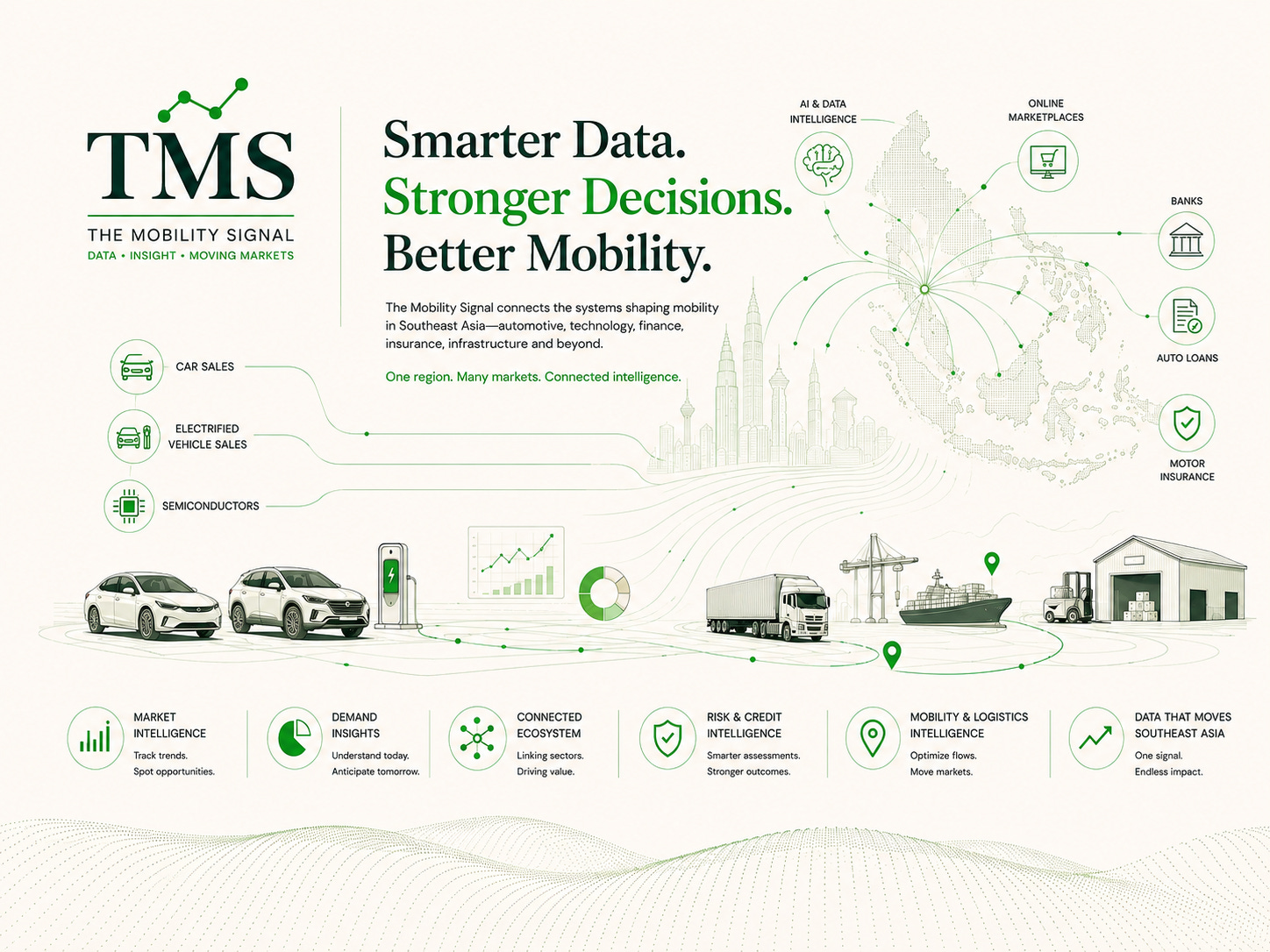
Our starting point is automotive and mobility, but our field of view is deliberately wider. A vehicle sits within a much larger economic system. It must be manufactured, distributed, marketed, financed, insured, serviced, powered and ultimately resold. Increasingly, it is also connected to software platforms, artificial intelligence, semiconductor supply chains, digital marketplaces and financial infrastructure.
Each part of that system has its own economics, data and competitive dynamics, but none operates independently. Changes in semiconductor technology affect vehicle capabilities and manufacturing costs. Electrification alters supply chains, infrastructure requirements and energy demand. Financing determines affordability and therefore adoption. Insurance influences the economics of ownership. Online marketplaces affect discovery, pricing and distribution, while logistics infrastructure determines how efficiently vehicles and components move across the region.
This is why we increasingly think in terms of the mobility economy, rather than the automotive industry alone. The most consequential changes often occur not within individual sectors, but at the points where they intersect.
That feels much more like TMS.
Then The Forces We Watch is exactly where proper bullets belong:
The Forces We Watch
The Mobility Signal follows the systems that are changing how Southeast Asian mobility markets operate. Our focus is not simply on whether a sector is growing, but on how structural changes alter competition, economics and market accessibility.
We are particularly interested in:
Automotive demand and market structure — vehicle sales, brand competition, distribution, pricing, used vehicles and changing consumer behaviour.
Electrification — EV and hybrid adoption, charging infrastructure, battery economics, energy systems and the competitive expansion of Chinese manufacturers.
Finance and credit — banks, automotive lending, leasing, affordability, interest rates, credit quality and the role financing plays in determining adoption.
Insurance and risk — motor insurance, claims economics, pricing, repair costs, new technology risks and the digitisation of insurance distribution.
Digital marketplaces and distribution — how consumers discover, compare, finance and purchase vehicles, and how software changes the economics of customer acquisition and distribution.
AI, software and semiconductors — the technologies increasingly shaping vehicles, manufacturing, underwriting, customer engagement and business productivity.
Logistics and infrastructure — ports, roads, warehousing, charging networks and the physical systems that enable regional commerce and mobility.
Industrial strategy and supply chains — manufacturing investment, critical minerals, batteries, trade flows, localisation and the changing geography of production.
Capital, policy and macroeconomics — regulation, industrial incentives, demographics, capital flows and the economic conditions that ultimately determine demand.
That list would also tie very naturally to the new master TMS visual we just created.
I would then add a second, shorter list that is even more important because it defines how TMS thinks, not merely what TMS covers:
What We Are Trying to Understand
Across these areas, we return to a common set of questions:
What is actually changing beneath the headline numbers?
Which changes are structural, and which are temporary?
Where is technology improving economics rather than simply attracting attention?
What determines whether a market is genuinely accessible to new entrants?
Where are financing, infrastructure or regulation constraining adoption?
How are competitive advantages shifting between incumbents and new entrants?
Which developments in one sector are likely to create consequences elsewhere?
What does the available data suggest about where the market is heading next?
That section, to me, is very TMS. It makes clear that this isn’t a content publication organised around categories. It is an analytical capability built around questions.
I’d also expand Beyond Headlines and Forecasts into two or three fuller paragraphs. There is an important distinction there that deserves more room:
Southeast Asia does not suffer from a lack of information. The region produces a constant stream of sales data, company announcements, investment commitments, regulatory changes, product launches and forecasts. The challenge is determining what those individual developments mean when placed in the context of how markets actually operate.
A new EV factory, for example, may signal industrial ambition, but its significance depends on local demand, utilisation, supply-chain depth, export economics and government support. Rising automotive loan volumes may indicate healthy demand, or they may conceal deteriorating affordability and greater credit risk. A new digital platform may appear disruptive while still struggling to overcome entrenched distribution economics.
This is where analysis becomes more valuable than aggregation. The objective is not simply to collect more information, but to connect market data with operating realities and understand the relationships between them.
That is probably the direction I would take throughout.
I’d also slightly reconsider the end. Rather than finishing with several short declarations, I’d make the final section one substantial closing argument followed by a single strong final sentence. Something like:
What The Mobility Signal Is For
The Mobility Signal is intended for people making decisions within these markets: operators deciding where to invest, automakers assessing competitive change, banks and insurers evaluating risk, investors distinguishing structural opportunity from short-term enthusiasm, technology companies identifying where digital infrastructure can create value, and policymakers considering how industrial and technological change affects economic competitiveness.
We do not expect every market to develop in the same way, nor do we believe every new technology will produce the outcomes its advocates predict. Southeast Asia is too diverse for simple regional narratives. The purpose of our work is therefore to understand the differences between markets, identify the forces that matter most within each one, and connect developments that are too often analysed in isolation.
Our ambition is not to predict every turn. It is to build a clearer picture of how Southeast Asia’s mobility economy is changing, what is driving that change, and what it means for the businesses and institutions operating within it.
The signal is rarely one headline. It is the pattern that emerges when the pieces are connected.