


New here? Join The Mobility Signal for on-the-ground intelligence from Southeast Asia’s automotive and mobility markets, built for industry leaders, investors, private equity, venture capital and advisors who need to understand what is changing and what it means.
In 2023, Kaspi acquired Kolesa, Kazakhstan’s leading automotive marketplace. At first glance, the acquisition seemed unusual, why would one of Central Asia’s most successful fintech companies buy a vehicle marketplace?
While the deal could be viewed as a natural expansion beyond banking into an adjacent category, the deeper rationale is far more interesting. The real value of Kolesa was not the advertising revenue it generated, but the access it provided to consumers at the moment they began researching one of their most significant purchases.
As financial products become increasingly commoditized, competitive advantage is shifting toward customer acquisition, distribution, and proprietary data. For decades, financial institutions started with financial products and then searched for customers. Kaspi reversed the model by owning the platform where consumers search, compare, and make purchase decisions, gaining access to customers before financing, insurance, payments, or other financial services were ever needed.
The marketplace became the acquisition engine, while financial services became the monetization layer, creating a platform capable of capturing value throughout the ownership lifecycle rather than simply a larger bank or a larger marketplace.
Across Southeast Asia, many of the region’s largest digital platforms already control significant consumer attention, while lenders, banks, insurers, and embedded finance providers continue searching for more efficient ways to acquire customers. As these industries become more closely integrated, Kaspi’s acquisition of Kolesa may offer an early glimpse into what the next phase of Southeast Asia’s digital economy could look like.
The growing integration of marketplaces and financial services reflects a broader reality: financial products can often be replicated, while customer access, distribution, and proprietary data are increasingly difficult to replicate. Kaspi recognized this early and built a platform designed to capture value across multiple stages of the ownership lifecycle.
Kaspi’s Ecosystem Strategy
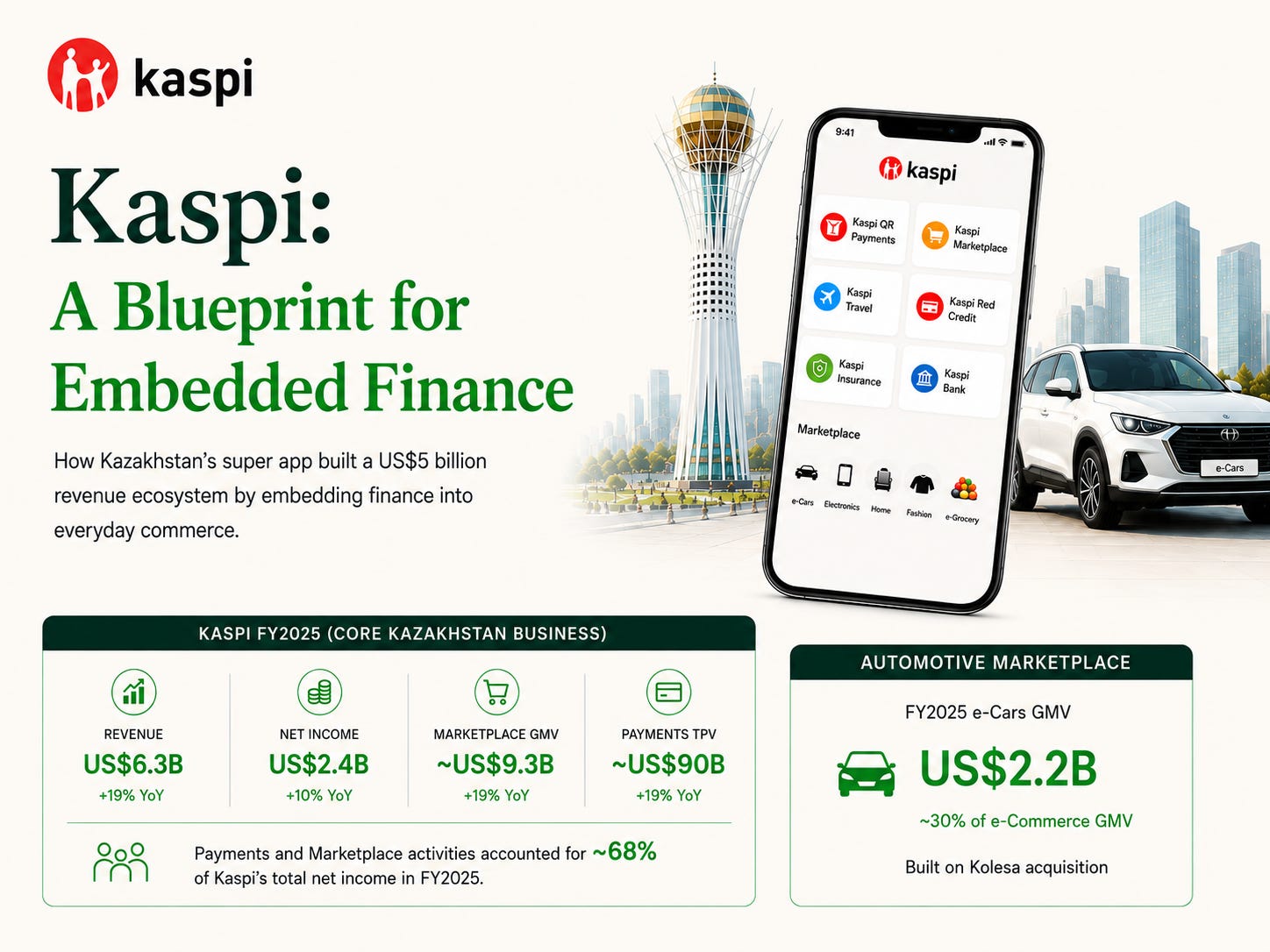
Kaspi is often described as a fintech success story, and the numbers support that characterization. In FY2025, the company generated approximately US$6.3 billion in revenue and US$2.4 billion in net income, making it one of the most profitable digital platforms in emerging markets.
Yet viewing Kaspi primarily as a financial-services company understates what it has actually built.
Its success did not come from creating a better loan product or payment system, but from connecting commerce, payments, and financial services in a way that increases customer engagement and creates multiple opportunities for monetization.
Today, Kaspi's marketplaces attract consumer demand, payments deepen engagement, and financial services generate revenue through lending, banking, insurance, and other embedded products. As more customers and transactions flow through the platform, each layer reinforces the others, creating advantages that are difficult for standalone banks, lenders, or marketplaces to replicate.
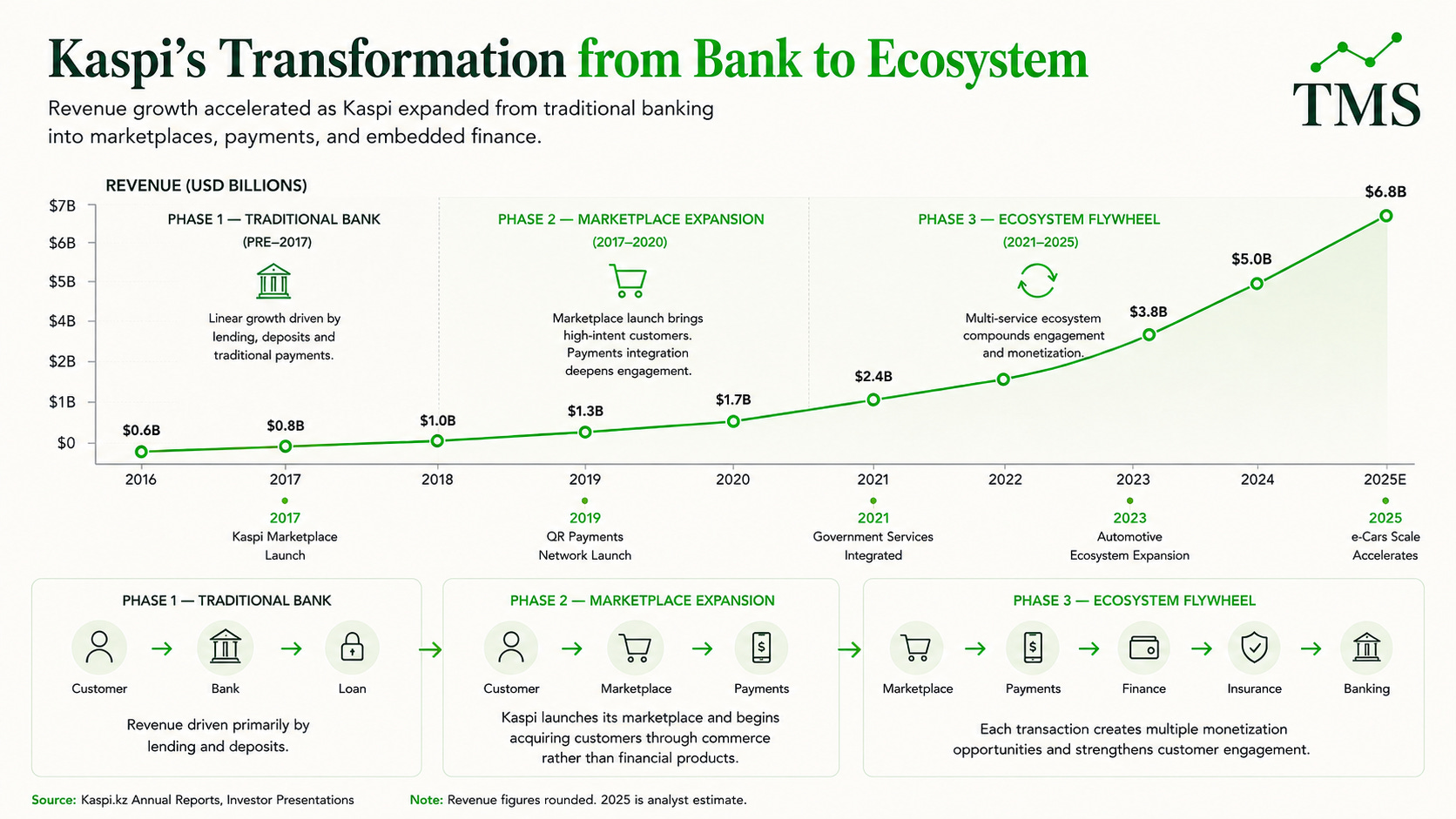
This helps explain why Kolesa was far more than a marketplace acquisition. Kaspi itself described the post-acquisition strategy as scaling products around the “car vertical” and integrating the marketplace with its payments, fintech, and government-services platforms, an indication that the value of Kolesa extended far beyond vehicle listings alone.
In isolation, Kolesa is an automotive marketplace connecting buyers and sellers of vehicles through listings, advertising, and related services. Within Kaspi’s broader platform, however, it provides access to customers at one of the most significant purchasing moments in their lives.
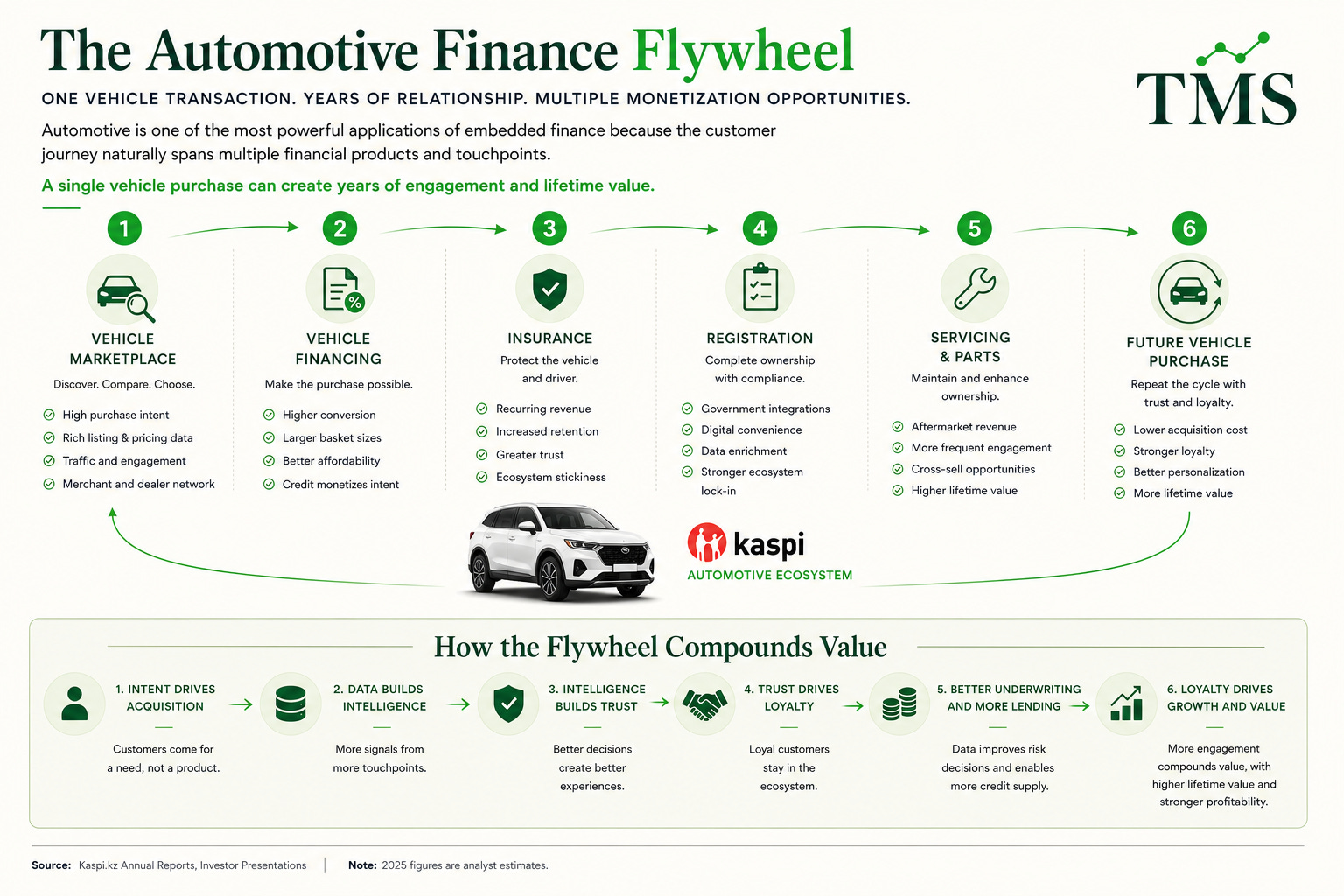
A vehicle purchase can become the starting point for financing, insurance, servicing, maintenance, and future replacement transactions, creating opportunities for engagement and monetization long after the initial sale. Rather than entering the customer lifecycle when financing is required, Kaspi seeks to engage consumers while they are still researching vehicles, comparing options, and making purchase decisions.
The most important lesson from Kaspi's strategy is not that it is entering new categories or acquiring additional products, but that it is positioning itself earlier in the decision-making process, allowing financial services to be distributed through customer relationships that already exist.
The Automotive Marketplace Opportunity
The significance of automotive marketplaces extends far beyond vehicle transactions. While the purchase itself is important, the broader opportunity lies in everything that follows. Financing, insurance, registration, servicing, maintenance, parts, toll payments, and eventual vehicle replacement create recurring interactions throughout the ownership lifecycle, transforming what appears to be a single transaction into a long-term customer relationship.
Historically, these interactions have been fragmented across multiple providers. The marketplace helped consumers discover vehicles, the bank provided financing, the insurer provided coverage, and service providers managed the ownership experience thereafter. Increasingly, digital platforms are attempting to connect these interactions within a more integrated customer experience.
What begins as a vehicle purchase can evolve into years of financing, insurance, servicing, and future replacement transactions.
Kaspi’s experience illustrates the economics of this model. By FY2025, payments and marketplace activities contributed approximately 68% of total net income, highlighting how commerce and transaction activity increasingly drive value creation across the platform. The automotive vertical has become one of the clearest examples of this strategy in practice, with e-Cars generating approximately US$2.2 billion in GMV during FY2025.
The value of automotive marketplaces extends beyond audience size alone. Consumers visiting these platforms are often researching one of the largest purchases of their lives, creating a combination of high purchase intent and trusted customer relationships. By helping customers discover vehicles, compare options, connect with dealers, and complete purchases, marketplaces establish valuable relationships before financing, insurance, or other financial products become relevant.
A useful example can be found in the Philippines, where AutoDeal facilitates more than 1,000 vehicle sales each month and participates throughout the decision-making process, from vehicle discovery and comparison to dealer engagement and purchase.
The platform’s strategic significance extends beyond vehicle transactions themselves. By engaging consumers while they are still researching and comparing vehicles, AutoDeal already participates in one of the most influential stages of the ownership lifecycle. The more important question is not how many vehicles are sold through the platform, but how many ownership-related services can ultimately be connected to that customer relationship.
A more integrated model would allow financing, insurance, payments, servicing, maintenance, and future vehicle purchases to be connected around a single customer experience. In that scenario, the marketplace evolves from a customer acquisition channel into a platform that remains relevant throughout the ownership lifecycle, creating opportunities for deeper engagement, richer data, and additional monetization over time.
Viewed through this lens, the value of an automotive marketplace lies not simply in its audience or transaction volume, but in its ability to establish customer relationships before financial products are needed and remain relevant throughout the ownership journey.
The Data Advantage
By engaging consumers before, during, and after a vehicle purchase, automotive marketplaces occupy a unique position within the ownership lifecycle. While lenders and insurers typically interact with customers only when financing or coverage is required, marketplaces can observe a much broader range of customer activity, from initial research and vehicle comparison to purchase, ownership, and eventual replacement.
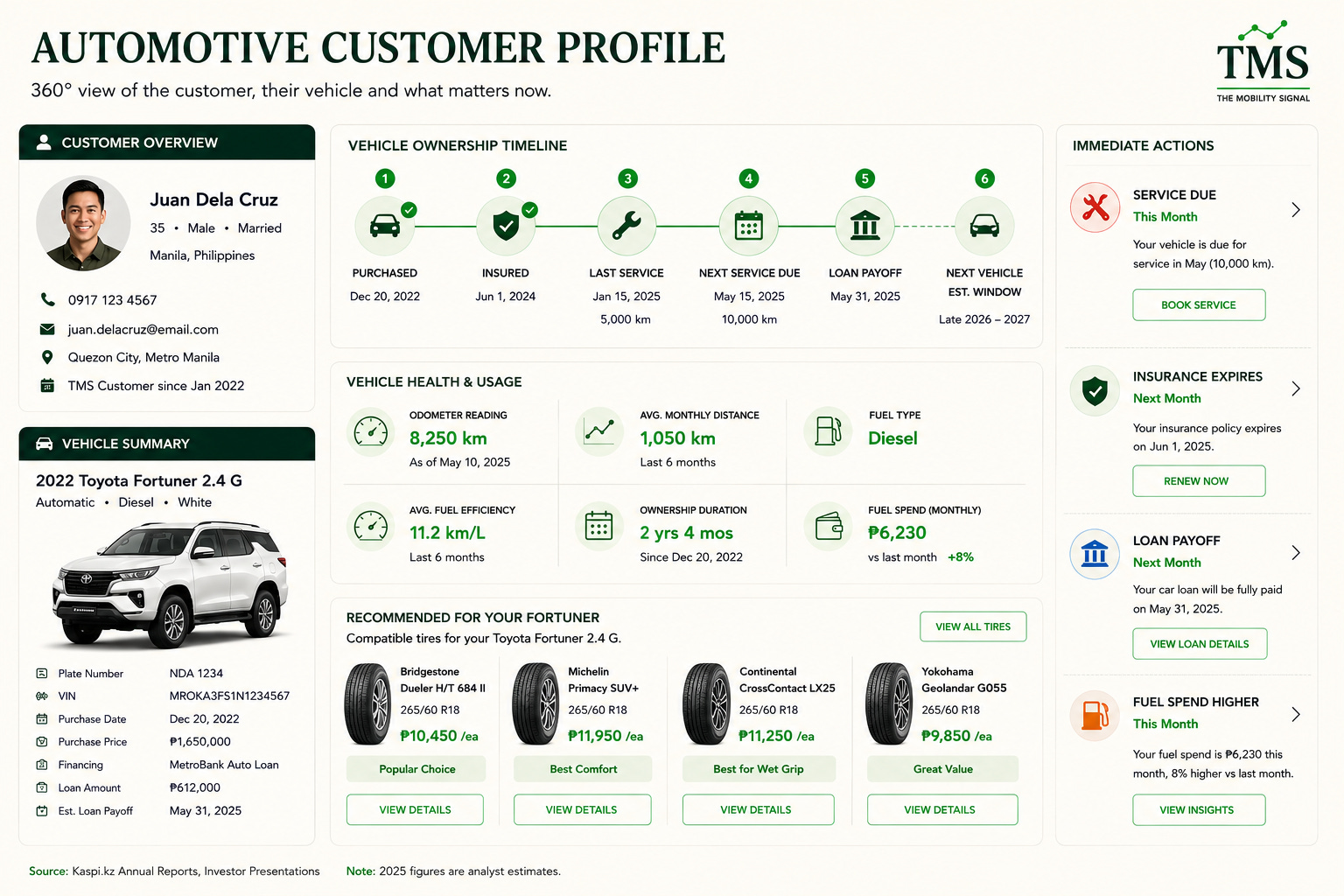
Each interaction generates valuable signals about preferences, timing, affordability, and future purchasing intent. Over time, these signals combine with transaction data to create a longitudinal view of the customer that extends far beyond a single purchase, allowing marketplaces to develop a deeper understanding of customer needs than any individual lender, insurer, or service provider can achieve in isolation.
As customer profiles become richer, value increasingly shifts from individual financial products to the ability to anticipate customer needs before they become financial transactions.
The marketplace therefore becomes more than a distribution channel. It evolves into a source of proprietary intelligence that helps connect consumers, dealers, lenders, insurers, and service providers through data-driven insights that can improve underwriting, personalization, risk assessment, and product recommendations.
For financial institutions, those insights may ultimately be more valuable than the financial transaction itself.
Why This Matters Now
The growing integration of marketplaces and financial services is being driven by fundamental changes in customer acquisition and distribution.
For decades, banks relied on branch networks as their primary route to customers. Large incumbent institutions invested heavily in physical infrastructure, creating trusted brands, extensive customer relationships, and significant barriers to entry. Customer acquisition was expensive, but once established, these advantages were difficult to replicate.
Digital banking changed the economics of financial services. New lenders, banks, and embedded finance providers can operate with far lower costs than traditional institutions, but they face a different challenge: acquiring customers efficiently and at scale.
At the same time, incumbent financial institutions face growing pressure as consumers increasingly research, compare, and purchase products through digital channels. As more customer interactions move online, the risk is not simply losing transactions, but losing relevance during the earliest stages of decision-making.
Both groups are therefore searching for more effective forms of distribution. Digital financial institutions need lower customer acquisition costs and stronger intent signals, while incumbents need new ways to engage customers before financial products are required.
Marketplaces offer a potential solution because they engage consumers while purchase decisions are still being formed.
Unlike traditional financial channels, marketplaces engage consumers while purchase decisions are still being formed. Whether buying a vehicle, searching for a home, booking travel, or making another major purchase, customers arrive with a clear objective and valuable signals about future financial needs.
This helps explain why partnerships between marketplaces and financial institutions have accelerated globally. One side controls customer demand and distribution, while the other provides financial products. Increasingly, both sides are recognizing that greater value can be created when those capabilities are more closely integrated.
Underlying these developments is a realization that many financial institutions are only beginning to recognize:
The future of finance may not belong to the company that builds the best loan, insurance policy, or payment product. It may belong to the company that owns customer demand, gathers proprietary intelligence, and engages customers before those products are needed.
Southeast Asia: A Similar Opportunity Emerging
Although Kazakhstan and Southeast Asia differ significantly in scale, market structure, and regulatory complexity, many of the dynamics that enabled Kaspi’s success are increasingly visible across the region.
Automotive platforms are becoming important gateways to consumer intent, while banks, lenders, insurers, and embedded finance providers continue searching for more efficient ways to acquire customers. As a result, the interests of both groups are becoming increasingly aligned.
Unlike Kaspi, where commerce, payments, financing, insurance, and ownership services increasingly operate within a connected platform, Southeast Asia’s automotive value chain remains fragmented. Marketplaces, lenders, insurers, payment providers, and ownership-service businesses typically operate independently, each controlling only a portion of the overall ownership experience.
The necessary building blocks already exist. Platforms such as AutoDeal, Carsome, and Carro engage consumers during vehicle discovery and purchase consideration, while banks provide financing, insurers provide coverage, payment companies facilitate transactions, and service providers manage ownership and maintenance.
The opportunity lies not in creating new products, but in connecting existing services around a shared customer experience.
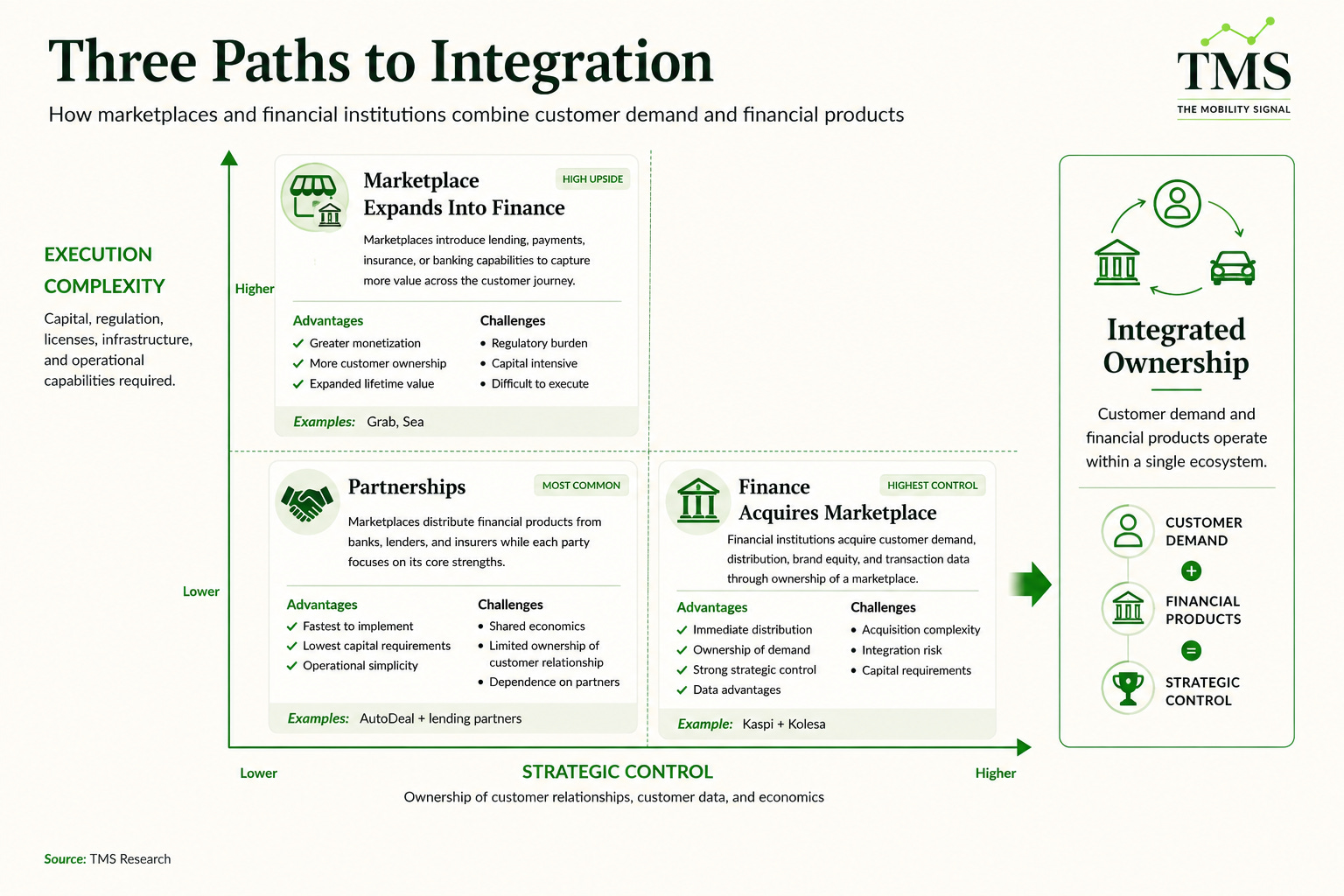
Integration can occur in several ways. Some marketplaces may expand into financial services by embedding financing, insurance, payments, and other ownership-related products directly into their platforms. Others may deepen partnerships with financial institutions while remaining focused on customer acquisition and engagement. In some cases, financial institutions themselves may acquire customer-demand platforms, following a path similar to Kaspi's acquisition of Kolesa.
Partnerships are often the natural starting point because they require less capital, can be implemented quickly, and allow each participant to focus on its core strengths. However, they frequently capture only part of the opportunity. Customers are handed from one provider to another, data becomes fragmented, economics are shared across multiple participants, and no single organization develops a complete understanding of the customer.
As more services become connected, the potential for personalization, proprietary intelligence, and long-term value creation increases. This is particularly important in automotive because the relationship extends far beyond the initial vehicle purchase. Financing, insurance, registration, servicing, maintenance, parts, toll payments, and eventual vehicle replacement all create opportunities for engagement over many years.
Organizations that participate across more of these interactions gain not only additional revenue opportunities, but also deeper customer insights and stronger strategic positioning.
Viewed through this lens, Southeast Asia does not lack the components of a Kaspi-like model.
It lacks integration between them.
Conclusion
Kaspi’s acquisition of Kolesa may ultimately be remembered as more than a fintech company entering automotive classifieds. It illustrates a broader evolution in financial services, where competitive advantage is increasingly being created through customer access, distribution, and data rather than financial products alone.
For decades, financial institutions built products first and then searched for customers. Increasingly, the companies creating the most value are reversing that equation by engaging consumers earlier in the decision-making process and building financial services around those interactions.
The implications extend far beyond Kazakhstan. Across Southeast Asia, automotive platforms, e-commerce companies, super apps, banks, lenders, insurers, and payment providers are all competing to become the primary point of engagement between consumers and financial services. The question is no longer simply who can offer the best loan, insurance policy, or payment solution, but who can engage customers earliest, remain relevant longest, and develop the deepest understanding of their needs over time.
In automotive, the opportunity is particularly compelling. A vehicle purchase is not a single transaction but the beginning of a lifecycle that includes financing, insurance, registration, servicing, maintenance, payments, and eventual replacement. Each interaction creates additional opportunities for engagement, insight, and value creation.
The companies that succeed may not be those that control a single product, but those that connect the greatest number of these interactions into a seamless experience.
Kaspi understood that owning the marketplace meant owning the starting point of that lifecycle. Southeast Asia now has many of the same ingredients in place, from automotive platforms and embedded finance providers to banks, insurers, and digital payment networks.
As customer acquisition, distribution, and proprietary intelligence become increasingly valuable, the future winners may be determined less by the financial products they manufacture and more by their ability to engage customers before those products are needed.
The road to financial services may no longer begin with finance itself.
It may begin with customer ownership.