


New here? Join The Mobility Signal for on-the-ground intelligence from Southeast Asia’s automotive and mobility markets, built for industry leaders, investors, private equity, venture capital and advisors who need to understand what is changing and what it means.
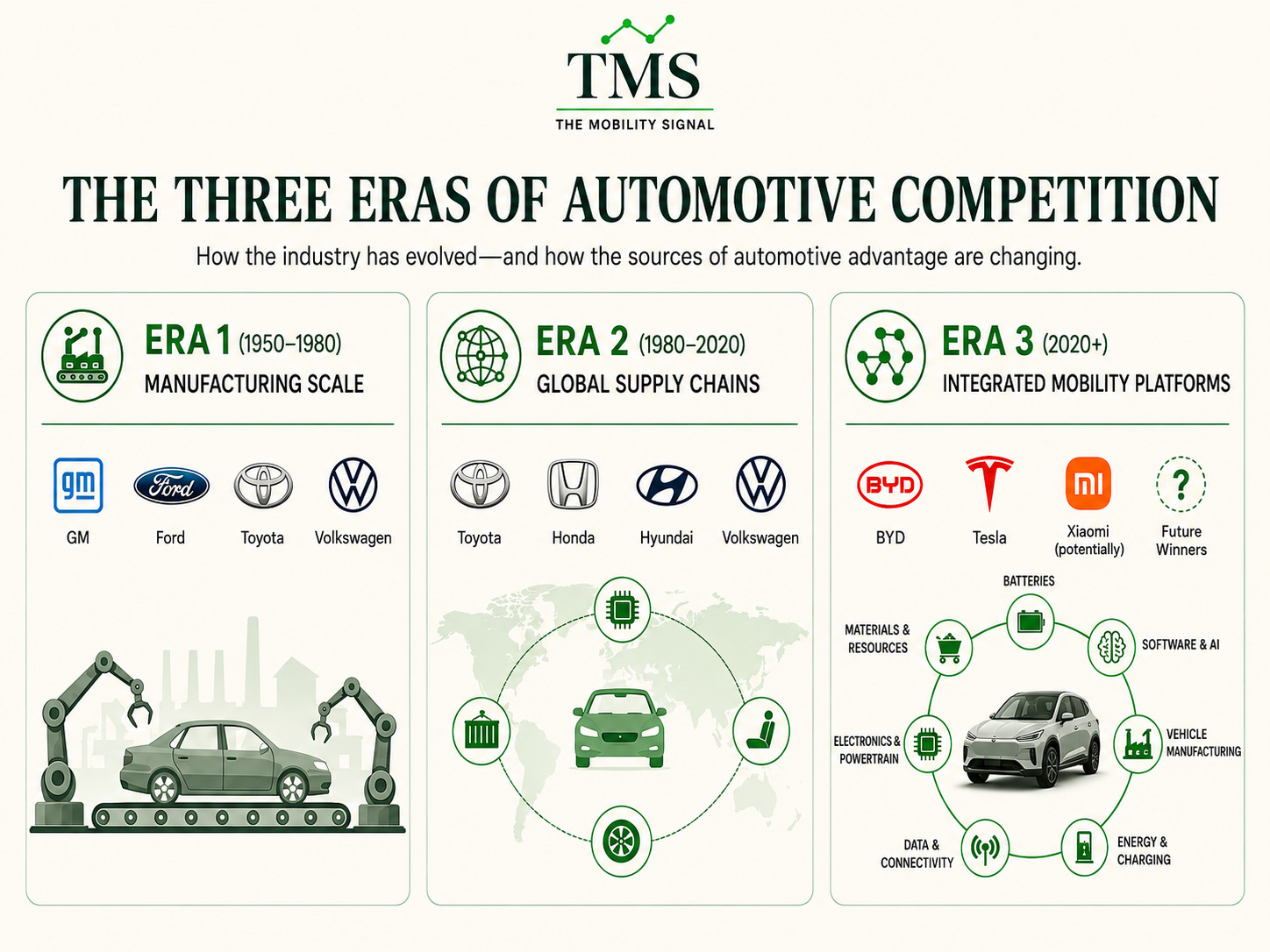
For much of the past half-century, the global automotive industry was built around specialization, within the overall supply chain. Automakers focused on vehicle development, manufacturing, brand management, and distribution, while specialist suppliers produced everything from engines and transmissions to semiconductors, electronics, glass, and interior components.
This model supported the development of large automotive ecosystems across the United States, Europe, and Japan, each built around closely connected supplier networks that accumulated scale, expertise, and manufacturing capability. Automakers did not need to own every part of the value chain because specialist suppliers could develop individual technologies more efficiently. Competitive advantage came from coordinating the system, maintaining quality, and bringing thousands of components together into a reliable finished vehicle.
The transition towards electric and software-defined vehicles began to disrupt the established supplier-based ecosystem as batteries, semiconductors, software, power electronics, connectivity, and energy-management systems became central to vehicle cost, performance, and customer experience. Unlike many traditional automotive components, these technologies are closely interconnected and cannot always be optimized independently.
China approached the emerging EV industry from a different starting point, drawing less on an automotive ecosystem built around engines, transmissions, and mechanical supply chains, and more on capabilities developed through battery manufacturing, consumer electronics, telecommunications, and the production of mobile phones and other connected devices. These industries had already created deep expertise in batteries, semiconductors, electronics, software, rapid product development, and large-scale manufacturing, which China was then able to extend across the wider EV value chain, including mineral processing, battery materials, cell manufacturing, charging infrastructure, energy storage, logistics, and vehicle production.
BYD is perhaps the clearest expression of this model, having begun as a battery manufacturer before expanding into electronics and vehicle production, which gave it a fundamentally different starting point from traditional automakers adapting systems originally designed around the internal-combustion engine. That background allowed the company to build capabilities across batteries, electric motors, power electronics, semiconductors, software, manufacturing, energy storage, and global logistics, creating a level of integration rarely seen in the modern automotive industry.
The automotive industry is therefore entering a new phase in which the established ecosystems of the United States, Europe, and Japan, built around manufacturing scale, engineering expertise and supplier coordination, are competing with a Chinese ecosystem developed more directly around batteries, electronics, software, energy, and vertically integrated EV production.
The automotive industry is shifting from optimizing individual parts of the supply chain to optimizing entire systems
Why EVs Changed the Rules
Electric vehicles are organized around a more closely connected technology stack. Battery chemistry influences range, charging performance, safety, weight, and vehicle packaging, while software and power electronics determine how efficiently that energy is managed. Semiconductors support the vehicle’s control systems, connectivity, and driver-assistance functions, and data generated by connected vehicles can feed directly into future software, engineering, and product-development decisions. Changes in one layer now affect the performance of the others, making these technologies more difficult to optimize independently.
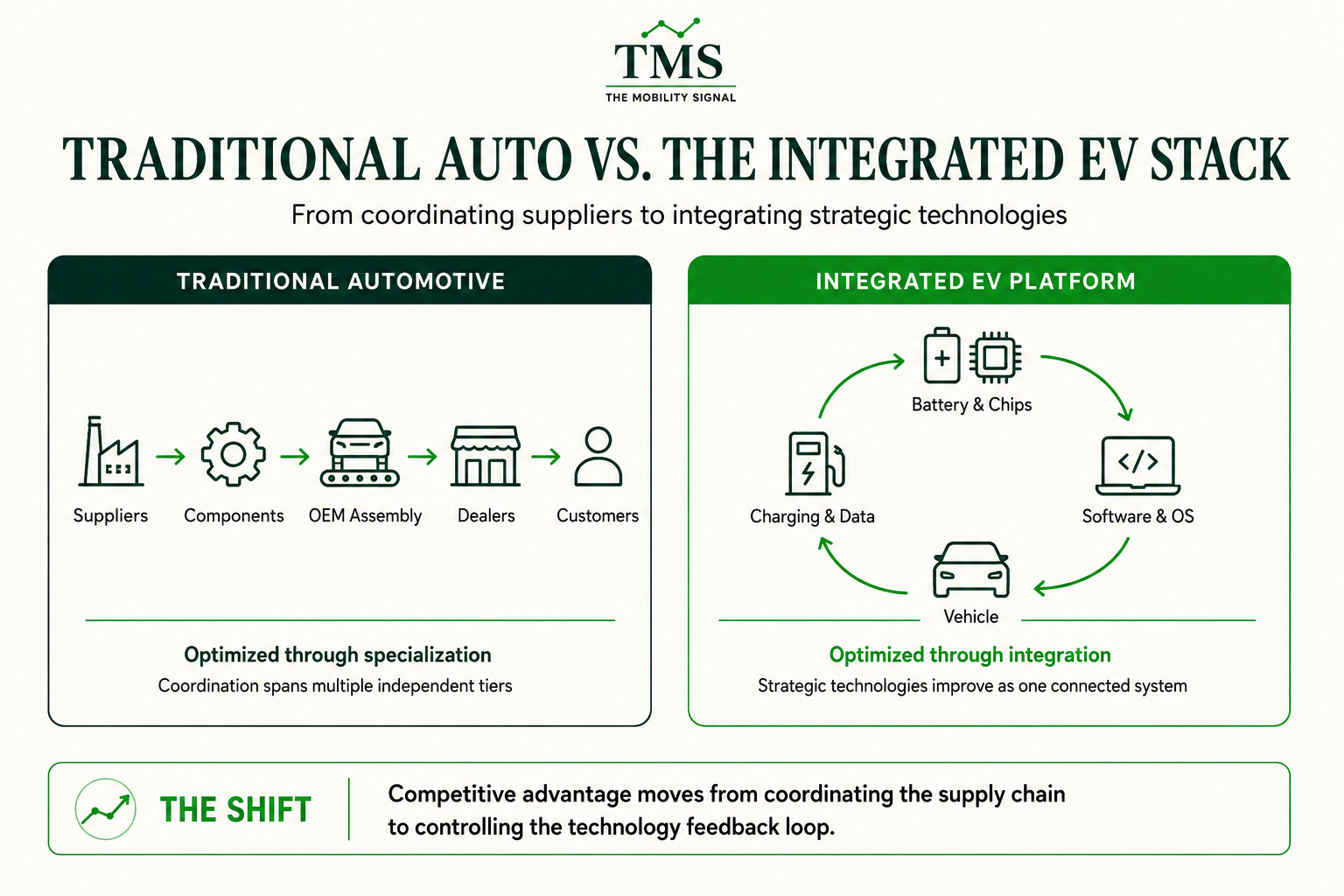
This increases the value of closer coordination between battery development, software engineering, electronics, vehicle design, and manufacturing. When these capabilities operate within the same company or a closely connected ecosystem, information can move more quickly, development cycles can shorten, and improvements can be introduced across both hardware and software. Competitive advantage therefore comes not only from manufacturing scale or supplier coordination, but also from controlling selected strategic technologies, shortening feedback loops, and improving the performance of the system as a whole.
China demonstrates how company-level integration can connect with a wider industrial ecosystem, combining control over selected strategic technologies with access to manufacturing capacity, infrastructure, engineering talent, and specialist suppliers across the broader economy. Tesla reached a similar conclusion from a very different starting point.
Tesla and BYD: Different Origins, Similar Conclusions
Tesla and BYD entered the automotive industry from opposite directions, with Tesla emerging from Silicon Valley with strengths in software, artificial intelligence, connectivity, and digital platforms, while BYD began as a battery manufacturer before expanding into electronics, semiconductors, energy systems, and vehicle production. Despite these different origins, both concluded that the technologies shaping vehicle performance, customer experience, and long-term competitiveness were too important to outsource completely.
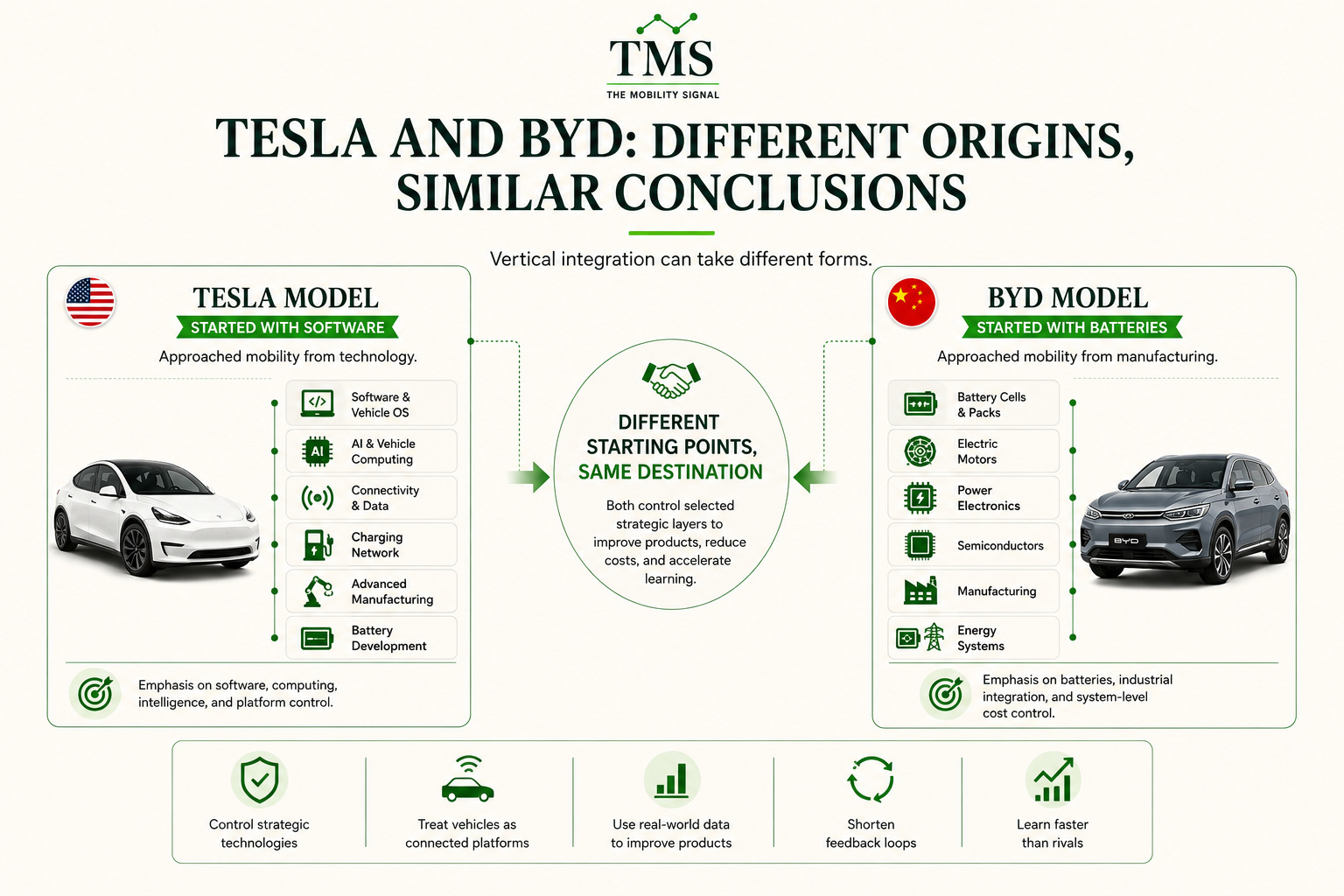
Their areas of emphasis reflect their different origins, but both seek greater control over the technologies that define vehicle performance, customer experience, and the information generated throughout the vehicle’s lifecycle. By treating vehicles as connected platforms rather than finished products, Tesla and BYD can use software updates, real-world data, and continuous product development to shorten feedback loops and improve future vehicles more quickly. Their convergence suggests that vertical integration is not a single model; companies may control different layers of the stack, depending on their strengths and partnerships, while reaching the same conclusion about the importance of strategic technology and organizational learning.
What This Means for Traditional Automakers
The convergence of Tesla and BYD does not mean that every established automaker must reproduce either model, but it does require manufacturers to reconsider which parts of the emerging technology stack remain suitable for conventional supplier relationships. The traditional system remains highly effective at producing complex, reliable vehicles at scale, although batteries, power electronics, software architecture, vehicle operating systems, and customer data now play a larger role in product cost, performance, development speed, and the customer relationship.
Toyota may be better positioned for this transition than is often assumed because its wider ecosystem already includes substantial capabilities in manufacturing, components, electronics, batteries, logistics, and mobility technology. It does not need to become Tesla or BYD, but it may need to coordinate its group of companies and strategic partners more like an integrated technology platform, retaining greater control over the capabilities that define the vehicle while continuing to rely on specialist suppliers where external expertise and scale remain advantageous.
Ecosystem vs. Ecosystem
The emerging automotive competition is no longer defined only by the capabilities contained within individual companies. Batteries, semiconductors, software, artificial intelligence, manufacturing, charging infrastructure, energy systems, research, capital, and government policy all influence the ability of an automaker to compete, meaning that brands now draw strength from the wider industrial ecosystems surrounding them.
China’s EV leaders benefit from a highly integrated network spanning battery materials, mineral refining, cell production, electronics, software, vehicle manufacturing, infrastructure, logistics, and energy storage. The concentration of talent, production capacity, suppliers, and intense domestic competition allows expertise and product improvements to move rapidly through the system, making speed and continuous learning as important to China’s advantage as cost and scale.
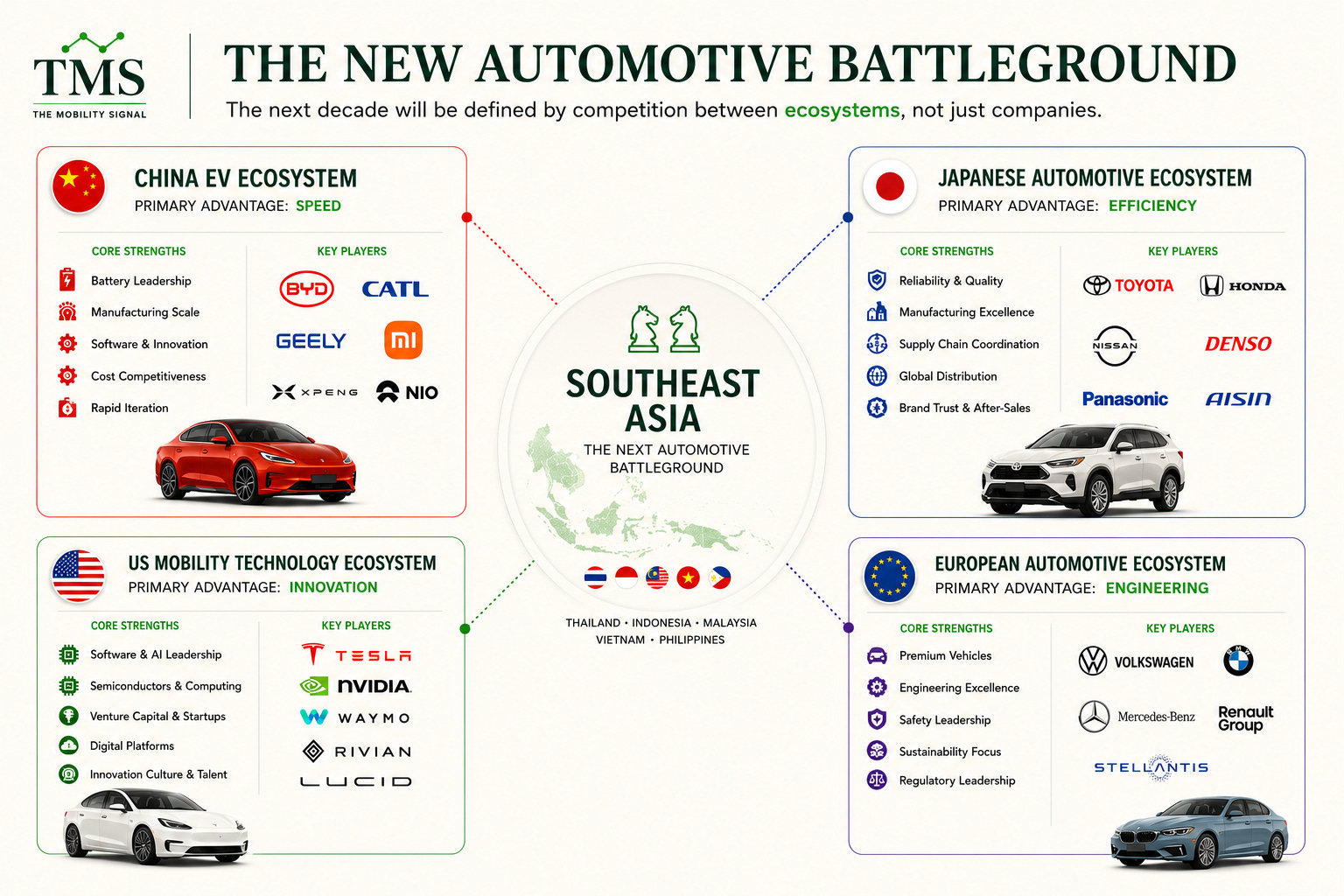
Japan represents a different model, built over decades around manufacturing excellence, quality, reliability, and close coordination between automakers and specialist suppliers. Japanese brands will continue to compete through their products, engineering philosophies, and customer relationships, but their future competitiveness may also depend on how effectively automakers, component manufacturers, technology companies, and research institutions combine their capabilities. Rather than reproducing BYD within each company, Japan may rely on a more federated form of integration in which critical technologies are controlled by individual manufacturers while expensive foundational capabilities are developed across the wider ecosystem.
The United States approaches mobility through its strengths in software, semiconductors, artificial intelligence, computing, venture capital, and technology commercialization. Tesla is the most visible automotive expression of this ecosystem, but companies such as Nvidia, Waymo, and a much broader technology sector will continue to shape the computing and intelligent systems used across the global automotive industry.
Europe continues to combine deep engineering knowledge, advanced manufacturing, safety expertise, regulatory influence, and globally recognized brands. Its challenge is to translate these strengths into more competitive software, battery, and production systems while managing the costs and complexity of the transition.
The next phase in automotive manufacturing may therefore be shaped less by which individual company possesses the strongest position today, but which ecosystem can integrate its capabilities, attract talent, generate learning, and adapt most quickly. Brands will remain the visible competitors in the showroom, but beneath them they will shift further toward the industrial systems of China, Japan, the United States, and Europe. We will clearly see this play out in the competitive broad markets of Southeast Asia.
Southeast Asia: Where the Ecosystems Collide
For all the discussion surrounding batteries, software, industrial policy, and automotive ecosystems, consumers ultimately want a good product at a competitive price. For decades, Japanese manufacturers mastered that formula across Southeast Asia, building reputations around reliability, durability, affordability, resale value, and strong aftersales support. In markets such as the Philippines, brands including Toyota, Honda, Mitsubishi, Nissan, Suzuki, and Isuzu became deeply embedded in the automotive landscape, creating levels of trust that were difficult for new entrants to challenge.
That position is now being tested by Chinese manufacturers offering a different combination of technology and value. Their vehicles now combine advanced driver-assistance systems, connected features, sophisticated interiors, and electrified powertrains at prices that are forcing established brands to respond. Consumers are consequently evaluating vehicles through a broader definition of value that includes software, safety, connectivity, energy costs, and overall product experience alongside traditional considerations such as reliability, service support, and resale value.
Southeast Asia is particularly important because the transition will not follow a single technological path. As explored in our earlier TMS article, The End of the ICE Era, electrification and the disappearance of the internal-combustion engine are related but distinct processes. Markets may become substantially more electrified while hybrids, plug-in hybrids, and range-extended vehicles continue to retain an engine for many years.
This creates a direct test of competing industrial strategies. Japanese manufacturers have generally pursued a multi-pathway approach, drawing on their hybrid expertise and introducing BEVs progressively as infrastructure and consumer demand develop. Chinese manufacturers entered without the same legacy investment in conventional engine production and have built their regional portfolios more heavily around BEVs, plug-in hybrids, and other electrified powertrains, supported by integrated battery supply chains, rapid product development, and localized manufacturing. Japan therefore brings manufacturing depth, dealer coverage, hybrid expertise, and long-standing customer trust, while China brings batteries, software, rapid iteration, aggressive pricing, and newer production investment. American technology continues to influence semiconductors, artificial intelligence, and vehicle computing, while European manufacturers retain strength in premium engineering, safety, and performance.
Few regions provide a clearer view of how these different capabilities perform under the same market conditions. The outcome will not be determined solely by which ecosystem possesses the most advanced technology, but by which can adapt its products to the different economic, infrastructure, and ownership realities of each Southeast Asian market.
Although automotive competition is shifting towards ecosystems, it will still be decided one vehicle at a time. Every purchase represents a judgement about technology, price, performance, reliability, and ownership experience, meaning that the ecosystems most likely to succeed will be those that translate their industrial strengths into products consumers genuinely value at the right price.
Core external references
International Energy Agency. Global EV Outlook 2026. 20 May 2026.
The strongest general source for EV manufacturing, battery supply chains, software-defined vehicles, Chinese production concentration, trade, and Southeast Asian competition.International Energy Agency. Global Supply Chains of EV Batteries. 10 July 2022.
Supports the description of the EV value chain from raw materials and processing through battery components, cells, and finished vehicles.World Economic Forum and Kearney. From Minerals to Megawatts: Building Resilience for EVs, Data Centres and Power Grids. December 2025.
Used for the wider value-chain framing, mineral processing, regional concentration, and the importance of coordination across industrial ecosystems. The report is also available in the research library.Adachi, Aya. China’s EV Rise and the Strategic Challenge for Japan’s Automotive Industry. Institut français des relations internationales, 29 April 2026.
Supports the China–Japan comparison, vertically integrated Chinese supply chains, pressure on Japanese manufacturers, and competition in Southeast Asia.Lyon, Peter. “The Secret Weapon Against China? Toyota Says It’s Collaboration.” Forbes, 27 July 2026.
Supports the discussion of Japanese manufacturers sharing and standardizing foundational components while continuing to compete in areas customers value.
Toyota and the Japanese ecosystem
Toyota Motor Corporation. “Toyota Production System.”
Supports the historical discussion of Japanese manufacturing efficiency, Just-in-Time production, supplier coordination, quality, and continuous improvement.Toyota Motor Corporation. “Guiding Principles at Toyota.”
Relevant to Toyota’s long-term relationships with business partners and its collaborative supplier philosophy.Toyota Motor Corporation. “Woven by Toyota to Accelerate Toyota’s Vision for Mobility.”
Supports the discussion of Arene as Toyota’s software platform and vehicle operating system, as well as software reusability and faster development.Toyota Motor Corporation. “Toyota Unveils New Technology That Will Change the Future of Cars.”
Supports the BEV Factory, modular vehicle construction, giga casting, self-propelled production, full OTA capability, and Toyota’s “all-in-one team” approach.Toyota Motor Corporation. “TMC Announces Changes to Organizational Structure and Senior Professionals/Senior Management.” 10 May 2023.
Supports Toyota’s dedicated BEV Factory and cross-functional integration with Woven by Toyota, major suppliers, and regional operations.
BYD and the Chinese ecosystem
BYD. “About BYD.”
Supports BYD’s origins, expansion across electronics, automobiles, energy, and rail transit, and its broader technology-company positioning.BYD. “Batteries.”
Supports BYD’s presence across battery cells, packs, consumer electronics, new-energy vehicles, and stationary energy storage.BYD. “BYD’s EXPLORER NO.1 Docks in Brazil, Elevating Sustainable Logistics.” 1 June 2024.
Supports the discussion of BYD’s vehicle-carrier strategy and the Explorer No.1’s capacity of up to 7,000 vehicles.BYD. “4.6 Million NEVs Sold Worldwide in 2025, with Exports Exceeding 1 Million.”
Supports BYD’s 2025 global sales and export scale.BYD. Investor Relations, “Periodic Reports.”
Appropriate primary source for company revenue, sales, investment, business-segment, and operational data.
Tesla and software-defined vehicles
Tesla. Impact Report 2025.
Supports Tesla’s wider vertically integrated model across vehicles, batteries, AI, energy, manufacturing, and supply chains.Tesla. “Software Updates” and “Upgrades.”
Supports the claim that Tesla vehicles continue to receive new features and improvements after delivery through over-the-air updates.Tesla. “Supercharger for Business.” 16 March 2026.
Supports Tesla’s description of deep integration across charging hardware, power electronics, software, network operation, and manufacturing.
Previous TMS research
The Mobility Signal.
Used for the Southeast Asian discussion, particularly the distinction between electrification and engine elimination, the multi-powertrain transition, and the differing strategies of Japanese and Chinese manufacturers.The Mobility Signal. Engine Transition Framework / Southeast Asian Powertrain Analysis.
The underlying analysis argues that Southeast Asia consists of several national transitions shaped by consumer economics, charging infrastructure, industrial policy, and manufacturing capability. It also distinguishes the multi-pathway strategy of Japanese manufacturers from the more electrified-first portfolios and vertically integrated supply chains of Chinese manufacturers.